
Talk To Expert
Mail Us

Trip Duration
14 Days
Group Sizes
2-20 People
Difficulty
Difficult
Max. Altitude
6,119 m
Activities

Meals

Accommodation
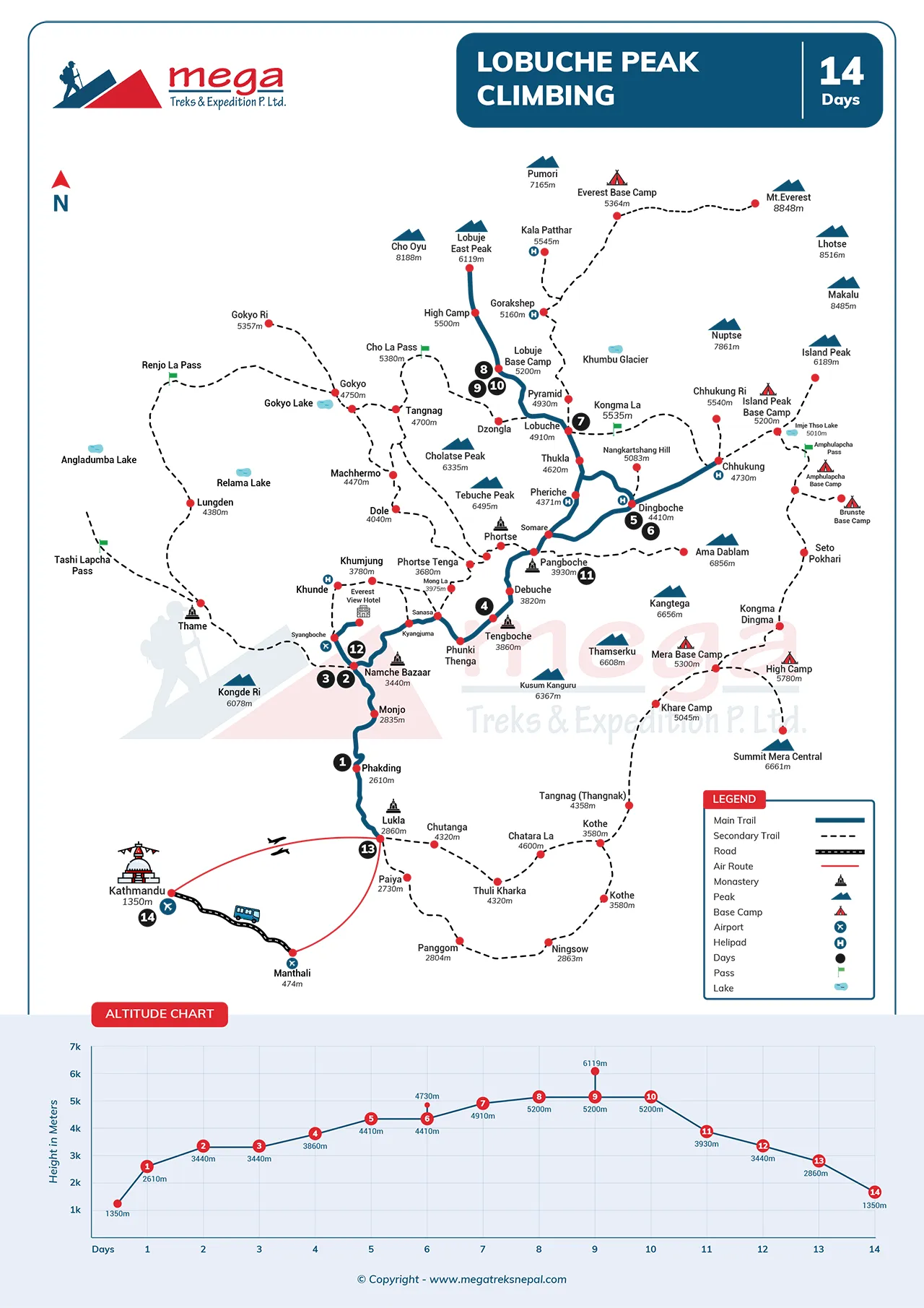
Lobuche Peak Climbing is an experience that will give rewards to both the trekking experience in the Everest region and the high-altitude trekking peak challenge. The trek takes a slow path through Lukla, Namche Bazaar, Tengboche, Dingboche and Lobuche, all the way up to the top of the Lobuche Peak (6,119 m / 20,075 ft). On the journey, the trekkers experience trekking through the old Sherpa villages, mountain valleys and the mountain terrain at high altitudes as they acquire experience in one of the best climbing areas in Nepal.
The adventure can be taken by trekkers who want to go a step further than the traditional trek. The path has acclimatization days to allow the body to adapt to the rising altitude before the peak attempt. On the lower parts of the mountain, climbers are instructed on how to use climbing gear and safety measures before proceeding to the higher parts.
A well-planned Lobuche Peak climbing itinerary gives sufficient time to acclimatize, prepare and make a safe summit attempt. The climb itself is not only physically challenging but also highly satisfying as it includes steep terrain with snow cover. The top is a great accomplishment after days of hiking and planning.
The Lobuche Peak Climbing Cost is determined by the duration of the trip, the number of people in the group, services provided, and the time of the year. The majority of the packages involve permits, guide services, lodging, meals during trek, domestic flight to and from Lukla.
Mega Treks supports climbers to have a safe and well-organized mountain experience with its experienced guides and well-crafted itineraries, and an excellent support system in the country. This trip provided a great experience of high-altitude climbing of a mountain in Nepal to individuals who are interested in a mix of trekking and mountaineering in the Everest region.
It starts with the scenic flight from Kathmandu to Lukla, which is one of the primary access points of the Everest area. Upon arrival at the Lukla Airport (2,840 m / 9,318 ft), the trekkers meet the trekking crew, pack their gear and start walking towards Phakding. The initial day is gradual along the local settlements, suspension bridges and forested parts along the Dudh Koshi River. This is the initial phase where trekkers can relax into the pace of the expedition as they take in the mountain atmosphere.
The path continues to build up over the next few days, progressing through Namche Bazaar and other significant villages, allowing the body to adjust naturally to the altitude before progressing to the higher altitudes where the climb will be.
Today you will fly to Lukla and thereafter start trekking to Phakding. The flight lasts approximately 35 minutes and lands at Lukla Airport (2,840 m / 9,318 ft). Upon arrival, you will have a brief rest, get ready to go on the trek and be led by your trekking guide, and then embark on the journey.
Abandoning Lukla, the path runs through Sherpa villages and along lines adorned with Mani walls inscribed with Buddhist mantras. On reaching the Pasang Lhamu Sherpa Gate, you will proceed to the permit checkpoint where the trekking permits will be verified. This path then passes down through oak, pine, and rhododendron woods to Chhepelung. It goes on to Thadokoshi with suspension bridges and along the Dudh Koshi River. Hiking along Ghad, you are slowly brought down into Phakding, where you will rest and get ready to continue on the days ahead.


Your trek will begin at Phakding and go on to Namche Bazaar. The trail traverses forests, villages and several suspension bridges as it gradually ascends in altitude. Leaving Phakding, you will cross the river and pass the settlements of Tok Tok, Zamfute, Chomoa and Monjo.
At Monjo, you will cross the Sagarmatha National Park checkpoint where trekking permits are checked, and you are allowed to proceed to the higher part of the Khumbu region. The path then goes on through a lengthy set of suspension bridges and then the main ascent to Namche Bazaar. This ascent must be at a gradual rate as the altitude rise is gradual.
As you proceed, you start seeing the mountains around you, with the first sight of Mount Everest. Within a few hours of walking, you will reach Namche Bazaar, a trading place in the Khumbu region, and will spend the night there.
Today is an acclimatization/rest day at Namche Bazaar. This additional day is significant, as it will give your body time to adjust to the elevation before going any further into the mountains. Instead of walking to a new place, you could spend the day sightseeing in Namche Bazaar and taking a rest.
In your spare time, you can go to the Sherpa Culture Museum that exhibits a piece of Sherpa life and culture. The other alternative is to go to Everest View Hotel, which offers a view of the Himalayan range around. You can also use your time to visit the town shops, tea houses, cafes and markets.
Namche Bazaar is a bustling village where trekkers often pause before entering the deeper Khumbu region. The day is meant to facilitate good acclimatization and yet enable you to enjoy the facilities and environment of the town. You will spend one more night in Namche Bazaar after a restful day and then go on with the trek.
Today you will be trekking from Namche Bazaar to Tengboche. The elevation gain is moderate; however, the trail involves uphill and downhill and is one of the more challenging trekking days of the trip.
The trek begins from Namche Bazaar (3,440 m / 11,286 ft). The initial part is a relatively flat trail that is not steep, then down into the valley below. The path down is boulder-strewn and dusty and ultimately reaches a suspension bridge over. You will cross the bridge after which you will be checked and then you will start the main climb of the day.
The trail leading to Tengboche is zigzag and steadily increasing in height. This part is one of patience and a leisurely pace since the path ascends again over the height at which the day began. As you go on the trail, you will slowly gain elevation to Tengboche (3,870 m / 12,697 ft). It will take you on to the Khumbu region where you will settle down and have the night before moving further up.
Today, you will trek from Tengboche to Dingboche. The trail is usually not as hard as the one the day before and has a more gradual course along the valley. The trek starts as a downward trip, starting at Tengboche and heading to the village of Deboche.
Going through Deboche, you will follow the path and pass next to several Mani walls and cross a suspension bridge to the other side of the valley. Then, after a fair walk of two hours or so, you will arrive at Pangboche, at which place a brief rest is generally taken.
The trail leads slowly to Dingboche beyond Pangboche. The path is fairly easy and can be walked at a slow pace and it ascends gradually. Mountainous views can be observed throughout the trip over the landscape around. Later in the afternoon, you will reach Dingboche (4,350 m / 14,272 ft). This camp is also a significant rest before the advancements to higher altitudes in the subsequent phases of the journey.
The trek today will be from Dingboche to Chhukung and return to Dingboche. It is regarded as one of the simplest trekking days of the trip, which is organized to assist in acclimatization before ascending to higher levels. The path takes a slow path along the river and a round-trip distance of about 9 kilometers.
As you leave Dingboche, you will go past the fringes of the village where there are several deserted stone houses. It is a dusty path with rocks, which leads slowly upwards towards Cho La. As you proceed through the valley, you can see Ama Dablam, Lhotse and Nuptse along the way.
You will have lunch and rest for a few minutes at a local tea house after arriving at Cho La before going back. Chhukung is a little village that has a few tea houses to cater to trekkers passing through the region. Following the break, you will follow the same path to go back to Dingboche, where you will spend the night.
Your trek will begin at Dingboche and go to Lobuche. The path slowly rises along the valley, and is quite comfortable in the first portion of the day. The higher the altitude, the more significant it is to keep the pace constant.
Most of the way, the trail is on a gentle incline but gets more challenging towards the end towards Pheriche and the Khumbu Glacier area. Going on through the valley, you will come to Thukla, a small settlement where a short rest is generally taken. And here starts the most difficult part of the day.
The path ascends sharply towards Thukla Pass. This part needs additional effort because the climb is steeper than the previous section of the hike. Once there, on the upper part of the trail, you will head towards Lobuche. At the end of the day, you will reach Lobuche (4,930 m / 16,175 ft) and spend the night.
Today you will trek from Lobuche to Lobuche Base Camp. The path is not very long when compared to past trekking days and does not entail a major increase in altitude. Leaving Lobuche, you will take the trail to Lobuche Base Camp and slowly increase in height on the way.
The path proceeds through a mountainous region and has a gradual path leading to the base camp. The day itself is not long-distance, even though it includes a number of hours of walking. A comfortable pace will also help you adapt to the elevation as you proceed with the journey.
Upon trekking for about 6-7 hours, you will reach Lobuche Base Camp (5,200 m / 17,060 ft). Once at the base camp, you can rest and spend the rest of the day there and then proceed with the expedition.
It is the main climbing day of the expedition today, and you climb Lobuche Peak. The day starts early and guides and Sherpas will give guidelines on climbing gear and safety measures before the start of climbing.
The climb is on snow-covered terrain which is steep in a few areas. To help the climbers with the more difficult sections of the route, fixed ropes are employed. Further up, rope lines can be added to assist the last line that is heading towards the summit. During the climb, care should be taken and one should follow the instructions of the climbing team.
Once on top of the Lobuche Peak (6,119 m / 20,075 ft), you will be able to enjoy the accomplishment before you start heading down the mountain. The return trip takes the same path back to Lobuche Base Camp. Several hours of ascending and descending will lead you to base camp, where you will rest after a very hectic yet satisfying day.
This day is a contingency day because the weather conditions could hamper the summit attempt on the scheduled day. In case the climb has been successfully done, the day may be spent in Lobuche Base Camp resting.
The additional day will allow the expedition to be more flexible and will assist in making the climbing schedule safer in case the weather in the mountains is unfavorable. In case of weather delays, the summit attempt can be made today instead. In case the expedition is on time, you will be able to have some rest in the base camp and be able to recuperate from the past days of trekking and climbing.
This free day will also provide time to communicate with loved ones and friends, to relax sore muscles, or just to appreciate the nature around the base camp site. Having a reserve day in the itinerary will give more chances to reach the peak and still keep a flexible and secure attitude towards alterations in the mountain circumstances.
You will be trekking from Lobuche Base Camp to Pangboche today. Having left base camp, you will go back via Lobuche and on through the Khumbu area. The path goes through Dingboche and Phoriche to Pangboche.
The lower the elevation, the more comfortable the trekking will be as you go further down than in higher areas that you came by earlier in the expedition. Pangboche has a reputation for having a monastery and cultural value in the region. There will be time to visit the village and get settled to spend the night.
Climbers and trekkers passing through the village are also a key destination of the village. Higher altitudes after several days give a relief in altitude after going to Pangboche. You will have nothing but to rest and recuperate and partake of the hospitality of the local folk before resuming the downward journey the next day.
You will trek from Pangboche and will go on to Namche Bazaar. The day entails a slow fall on already known trails that were used earlier on the uphill part of the trip.
On your way out of Pangboche, you will cross Tengboche on your way down on rocky trails. It should be done with care since there are loose stones and steep areas in some areas of the route. A constant speed will aid in making the descent more comfortable and secure.
Going down further, the air is becoming noticeably thicker and walking in it becomes much easier than at higher levels, which were achieved earlier in the journey. After several hours on the trail, you will arrive back at Namche Bazaar (3,440 m / 11,286 ft). The journey back to this bustling settlement is a significant milestone in the journey. The rest of the day may be used up in relaxation and contemplation of the climbing experience before the final steps of trekking.
Today you will trek from Namche Bazaar to Lukla. It is the last day of the trek and is a relatively downward path to the lower part of the Khumbu region.
Leaving Namche Bazaar, the path slowly leads down through forests, villages and crossing suspension bridges that you had met in the first part of the journey. You will then see the last point, which you will reach after about an hour of trekking, whereby you will see Mount Everest before moving further down the valley.
The path proceeds along the path of the steps of stone and through known settlements to Lukla. Downhill trekking can be an easier experience than climbing, but it can strain the knees after several days on the trail. After covering the day’s distance, you will arrive in Lukla (2,850 m / 9,350 ft). This last night in the mountains is a chance to celebrate the end of the trekking and climbing part of the expedition.
Today, you will be traveling back to Kathmandu via Lukla. You will spend your last night in the mountains, after which you will have breakfast and be taken to the airport where you will travel back.
It is a 35-minute flight from Lukla to Kathmandu, which provides the final aerial perspective of the Himalayan area. As the plane clears the mountains, the scenery slowly transforms to rough terrain and to the bustling Kathmandu Valley.
The trekking and climbing adventure officially ends when people arrive in Kathmandu. The rest of the day may be spent resting or on personal activities or on preparations for further traveling. The Everest region is characterized by the need to trek and climb mountains, and the end of a successful mountain experience is the moment when the capital city is returned to after almost two weeks of traveling.

You can cutomize this trip as per your requirements if met the proper guidelines.


Lobuche Peak Climbing can best be done in the spring and fall when the weather is more stable, and visibility is improved. Spring (March – May) has average temperatures and mountain views. This season is popular among many climbers as the trails are in activity and the weather is generally conducive to trekking and climbing. Another widely used season is autumn (September – November) because the weather is dry, and visibility is very good following the monsoon season.
Winter climbs can be done but with colder conditions and an increased possibility of a snow covering. Rain, clouds, and potential flight delays during the monsoon season (June to August) make traveling and climbing in the Everest region more difficult in general.
Lobuche Peak Climbing is a combination of a trek in the Everest region and a summit ascent of one of the trekking peaks that are famous in Nepal. The total distance is about 120 kilometers, which varies according to the itinerary and the acclimatization plan. This trip begins in Lukla (2,840 m / 9,318 ft) and passes through Namche Bazaar, Tengboche, Dingboche and Lobuche.
The trail slowly becomes elevated to allow the climbers to adjust safely before getting to the higher regions. Lobuche Base Camp is located at approximately (5,200 m / 17,060 ft), while the summit of Lobuche Peak stands at (6,119 m / 20,075 ft). A Lobuche Peak Climbing Itinerary with a proper plan would enable gradual elevation rise and sufficient acclimatization before the peak attempt.
Lobuche Peak Climbing is regarded as a difficult adventure and a mixture of high altitude and basic mountaineering practices. The walking path is via the fixed tracks, but the final part of the summit is a steep area, which needs climbing gear. Past trekking experience is useful, though it is equally important that one is determined and well prepared. Altitude is one of the greatest problems.
The more the climbers ascend (above 5,000 m / 16,404 ft), the less oxygen is present, and the body needs time to adapt. The symptoms of altitude sickness can be headaches, fatigue, dizziness, and the loss of appetite. The use of a progressive ascent plan, hydration, and acclimatization days can greatly mitigate dangers and enhance the overall climbing experience safely.
Lobuche Peak climbing walking hours will depend on the terrain, altitude, and day-to-day goals. Shorter days are typically scheduled around activities of acclimatization or preparation and may include only 3-4 hours of walking. The average trekking days are 5-7 hours on the trail as the path gradually ascends through the Everest area.
The higher the altitude, the slower and more controlled the walking speed is. The peak day is usually the summit day that lasts between 7 to 10 hours, both the ascent and descent. The Lobuche Peak Climbing Itinerary helps distribute the workload evenly and allows climbers to adjust gradually to changing conditions during the expedition.
Lobuche Peak Climbing accommodation is primarily offered in tea houses and mountain lodges that are found along the trekking path. The rooms are usually modest, hygienic and trekker-friendly in the Everest area. Higher altitudes result in more primitive facilities because of the remote setting. Food usually consists of rice, noodles, soup, potatoes, bread, eggs and vegetables of the season.
Several lodges offer tea, coffee, hot chocolate and other warm drinks. It is also advisable to eat well and be hydrated during the journey at the higher altitudes. Mega Treks advises climbers to consume lots of fluids and eat balanced meals that help to maintain energy and recovery on the trekking and climbing days.
Lobuche Peak Climbing can be combined with several other routes to have a longer and more diverse adventure in the Everest region. Other climbers may include the Everest Base Camp before starting the summit, whereas others may include Kala Patthar to have more mountain scenery. The more seasoned trekkers could include the climb with Gokyo Valley and Cho La Pass in order to make a more extended route through various areas of the Khumbu region. These options will take more days and increased fitness. The choice of the route is based on the time, experience, and own interests.
Mega Treks will be able to assist the climbers in making the appropriate choice depending on their objectives and still having enough time to make the necessary acclimatization and attempt the summit safely.
Beginners are welcome to come to this trip, but they also need to realize that it is a physically challenging adventure. Although having some prior climbing experience is unnecessary, excellent fitness is strongly suggested. The hike is extremely high in altitude and the summit day entails the application of climbing gear on steep slopes. Beginner who have done other multi-day treks at moderate altitude tend to adjust seamlessly to the task.
The bottom line is that the experience can be significantly enhanced when properly prepared in advance. It is significant to proceed at a slow pace, follow the instructions of the guide and take time to get used to the environment. Through will and training, a lot of first-time climbers are able to reach the peak and complete the expedition.
Good physical preparation is important for Lobuche Peak Climbing. It is preferable to start training a few weeks before the trip and to strive to build up endurance, stamin and leg strength. Hiking, running, cycling and climbing up and down stairs may be practiced to get the body fit to spend much time on a long trekking day. Frequent workouts also enhance heart fitness and this is beneficial when walking in high altitudes.
Mental preparation is also essential since the adventure will be accompanied by low temperatures, unstable weather and challenging walking days that are challenging. The use of a small backpack in training hikes may be used to simulate a real setup of trekking. The high level of fitness provides the climbers with the opportunity to experience it more comfortably and increase their chances of making it to the top successfully.
Most tea houses along the way have charging facilities, but they become less common as you get to higher elevations. In certain locations, there might be a minimal fee to use charging points. It is advisable to always carry a power bank as an emergency, especially on longer days in remote places. Internet connection is common in most villages via local WiFi.
The connection speed is not good depending on the location and weather. In part of the Everest region, mobile network coverage is possible, but the signal strength reduces with increased elevation. Climbers cannot count on a steady internet connection during the trip and must be ready to spend some time without the internet during the expedition.
Lobuche Peak Climbing will need several permits. The Khumbu Pasang Lhamu Rural Municipality Permit and Sagarmatha National Park Entry Permit are required by trekkers who want to enter the Everest region. Lobuche being a climbing Peak, it is also necessary to have a climbing permit issued by the Nepal Mountaineering Association. These permits aid the control of tourism and also aid in conservation activities in the area.
Occasionally, permit requirements can vary and it is necessary to verify existing guidelines before travelling. Mega Treks takes care of the permits required during the trip, and climbers are not bothered with the administrative processes but concentrate on the preparation. It is always important to have permit documents with you during the trek.
The transportation for Lobuche Peak Climbing will commonly start with a domestic flight between Lukla and Kathmandu. The flight lasts about 35 minutes and is the primary entry point to the Everest region. Sometimes weather conditions may have an influence on flight schedules, especially during the peak seasons of trekking. All the traveling is done on foot as it finally arrives in Lukla, and the rest of the expedition is by air before the final flight back.
The trip down to Kathmandu is the same way as up to Lukla and then a flight back to Kathmandu. Some itineraries can involve road transport to alternative flight departure points during peak seasons. The transport arrangements are normally planned early enough to have a smooth commencement and end of the journey.
Anyone who is taking part in Lobuche Peak Climbing is highly advised to take travel insurance. High altitude trekking and climbing activities to the highest level attained during an expedition should be covered by an appropriate policy. Coverage of emergency helicopter evacuation is especially crucial since medical help in the mountainous areas may be costly. Whenever possible, medical treatment, trip interruption and personal accident coverage should also be covered with insurance.
The climbers are advised to go through the terms of a policy before buying the policy to ensure that mountain activities are covered. It is advisable to carry with one a copy of the insurance details along the trek. The right insurance will offer extra reassurance and will assist in dealing with unforeseen circumstances on the expedition.
Lobuche Peak Climbing is a trekking, acclimatization and mountaineering expedition in the Everest region. The trip goes through the ancient Sherpa villages, mountain valleys and high-altitude regions to Lobuche Base Camp. Climbers will slowly accumulate altitude by a well-planned timetable that will facilitate sound acclimatization. The most challenging day of the expedition is the summit day, which involves physical effort, perseverance and utilization of climbing gear.
Participants get to experience the changing landscapes, remote mountain setting and living in Khumbu. The Lobuche Peak Climbing Cost is an adventure that can be seen as a combination of trekking and climbing into one adventure, and many people find it challenging and rewarding.
The climbers think that the summit day conditions and the elevation make the climb challenging, but with training and guidance, it is possible.
Past climbing experience is desirable but not necessarily a must. More important are good fitness and experience in trekking.
The itineraries last approximately 14 days, with acclimatization and contingency days.
Anyone may experience altitude sickness at high altitude; hence the inclusion of acclimatization in the itinerary.
The tea houses and mountain lodges on the trekking path are the primary places of accommodation.
Yes, the meals are normally covered during the period of trekking and climbing.
Tea houses offer both local and international dishes that include rice, noodles, soups, potatoes, bread and eggs.
Yes, high altitude trekking and emergency evacuation insurance is highly recommended.
Yes, most villages have charging amenities, but they typically require an extra charge.
Most of the villages have access to the Internet, but the speed and reliability are not consistent.
No strictly set age limit, but the participants must be physically fit and be able to cope with the trek.
It is advisable to book several months in advance of the desired departure date during the seasons.
The needs of personal equipment are package-based, but guides help with group equipment.
Season and elevation change temperatures and it can get very cold near the base camp and summit.
The itinerary will have a spare day to allow flexibility in case of weather changes that will impact the climb.
Yes, Mount Everest can be seen in a number of places on the hiking path.


 Write a Review


