
Talk To Expert
Mail Us


5/5 based on 37 reviews

Trip Duration
13 Days
Group Sizes
2 to 25 People
Difficulty
Moderate
Max. Altitude
5550 m
Activities

Meals

Accommodation
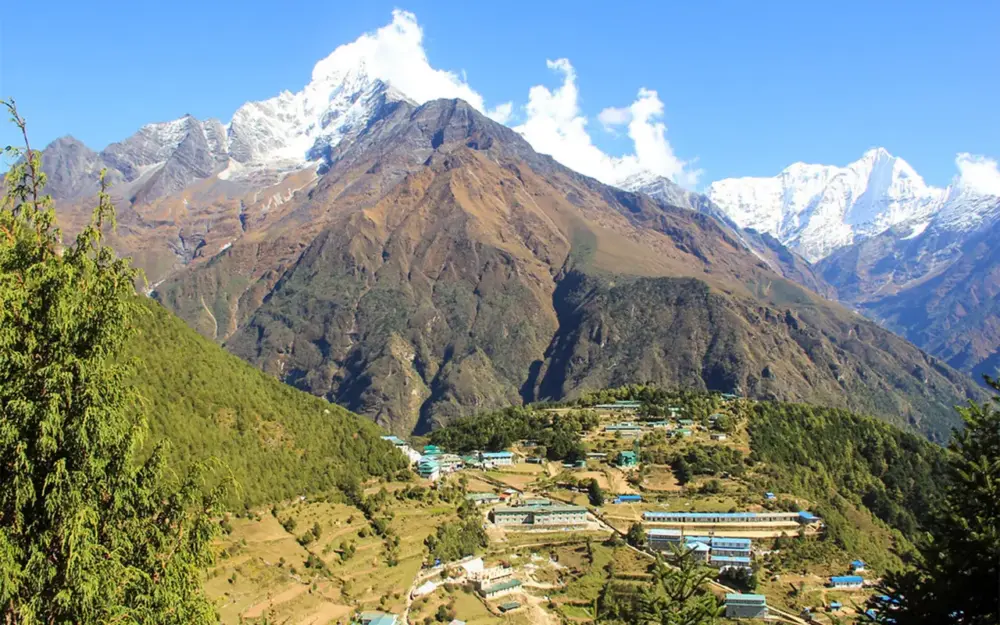
The Everest Base Camp Trek with Helicopter Return is an adventure that is both satisfying and offers an opportunity to experience one of the most well-known trekking trails in Nepal and a breathtaking flight on a helicopter. This trip will lead you to the core of the Everest area, which will enable you to explore mountainous landscapes, classic Sherpa villages, ancient monasteries, and spectacular Himalayan sightseeing. The path of the trek is slow and guides trekkers to adapt to the elevation as they experience the changing scenery on a daily basis.
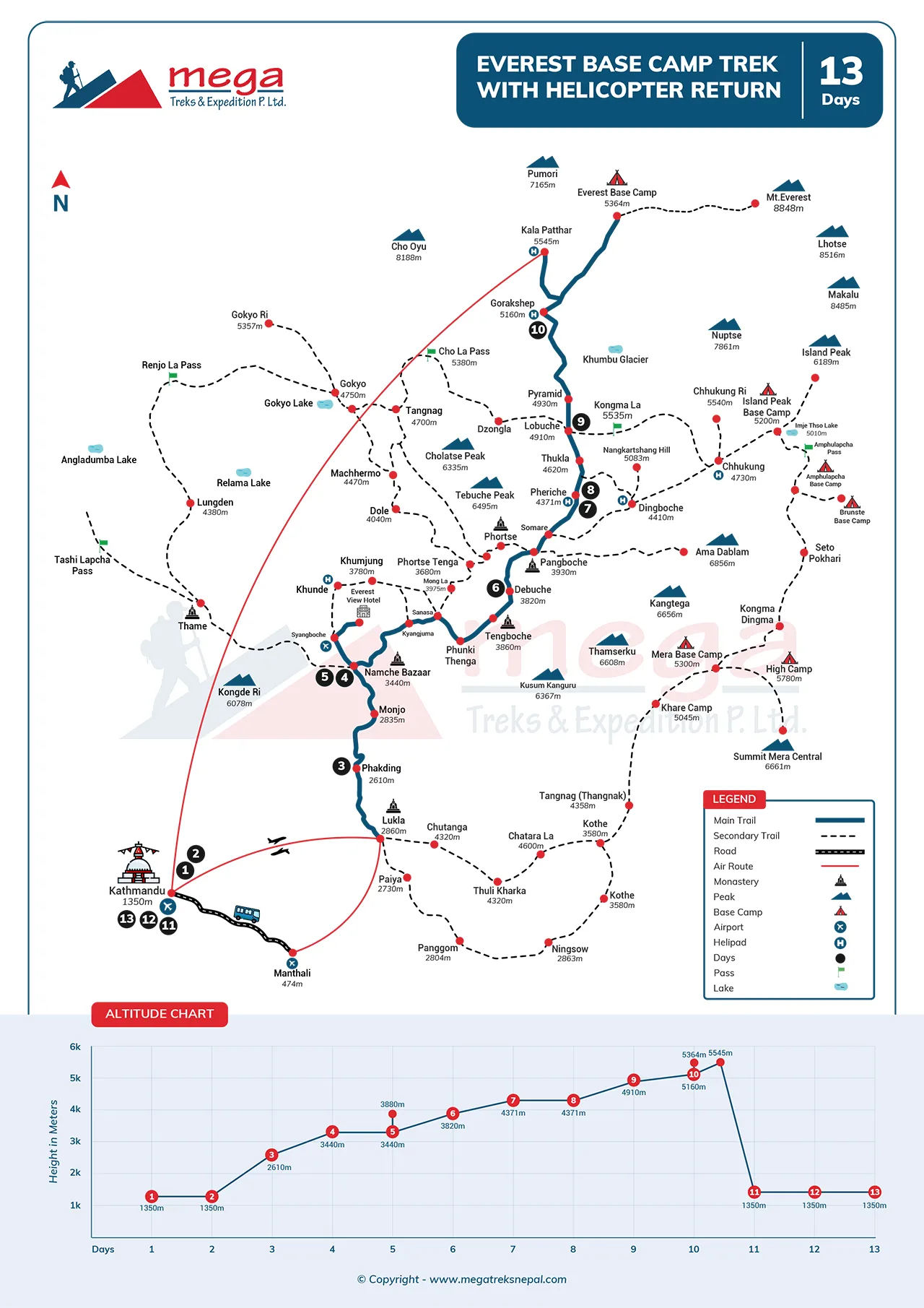
It starts by flight to Lukla and goes on to Phakding, Namche Bazaar, Deboche, Pheriche, Lobuche, and Gorakshep to the base of Everest (5,364 m / 17,598 ft). On the route, you will trek through woodlands, suspension bridges, and some of the settlements that have long received trekkers and climbers. The path also allows acclimatization days, which are safe to allow your body to adapt to the high altitudes.
A significant point of this trip is the trek to Kala Patthar (5,550 m / 18,209 ft), where the views of Mount Everest and the rest of the peaks are exceptional. Once the trek is completed, a helicopter flight will take you straight back to Kathmandu, and you save several days of walking back to Lukla. This renders the trip perfect for travelers wishing to explore the Everest Base Camp and spend their time effectively.
Everest Base Camp Heli Return Trek is the right type of trekking that is recommended to trekkers who want to have a balance between adventure and comfort. Not only does the helicopter flight shorten the total time of the turnaround trip, but it also offers memorable air vistas of glaciers, valleys, rivers, and mountain scenery.
Mega Trek is leading this trek using expert guides, a strong support team, and well-thought-out logistics to make sure that the experienced trekking trip is enjoyable. Be it a seasoned hiker or an aspiring beginner, this trip promises to be a great experience to see the Everest area. The Everest Base Camp Trek with Helicopter Return itinerary is a blend of the culture of the mountain, trekking and breathtaking flights in one unforgettable experience in the Himalayas.
This trek begins when you arrive in Kathmandu, where you will be received and taken to your hotel. The next day is normally spent on sightseeing and last trek arrangements. Once all the preparations are made, you will be flying early in the morning to Lukla, the opening to the Everest region. The trekking path begins at Lukla, where you commence your trek to Phakding amidst scenic mountainous rocky terrain and Sherpa villages. The trail slowly ascends into the Khumbu region in the subsequent days, which will enable you to immerse yourself in local culture, mountain landscapes and the thrill of hiking to the Everest Base Camp.
Our airport representative will meet you on your arrival at the Tribhuvan International Airport and will help you get to your hotel in Kathmandu. You will be checked in after a short drive to the airport and then you will be given time to rest after the journey. You can spend the remaining part of the day at the hotel or in the locality at your leisure time depending on the time of your arrival.
During the evening, you will have a welcome dinner where you will be introduced to the team and briefed on the next day’s trek. At this meeting, critical details concerning the journey will be presented such as the agenda and plans for the next day. A good time to ask your last questions and get ready for the adventure in front of you is to enjoy the first evening in Nepal.


The day will be spent in Kathmandu Valley visiting some of the most significant cultural and religious places. Your guide will meet you in the hotel after breakfast and start the sightseeing tour. The initial tour is the Pashupatinath Temple, which is one of the most important Hindu temples in Nepal and a UNESCO heritage site. You will then proceed to Swayambhunath Stupa, an ancient religious structure also a UNESCO World Heritage Site.
You will also explore Kathmandu Durbar Square and Boudhanath Stupa, two important sites in the valley, during the day. The sites are informative about the history, culture, and religion of Nepal. The sightseeing tour will be followed by visiting your hotel where the final preparations of the trek will be made. This is the most appropriate moment to pack your materials and make sure all is in readiness to go to the Everest Base Camp.
You will be travelling from Kathmandu to Lukla by air and trek to Phakding. In the morning, you are going to take a scenic flight to Lukla. You will be able to see the green hills, valleys, and mountain landscapes during the flight and finally land at Lukla Airport. Once you have been introduced to the trekking crew and packed your gear, you are officially off on the trek.
You will depart Lukla behind you and trace the path through the Sherpa villages and have scenic views of the surrounding hills and forests. The path cuts across scenic mountainous terrain and provides the initial near encounter of the Khumbu area. The path slowly leads to Phakding and serves as a pleasant introduction to trekking. When you arrive, you will rest in your lodge and have a rest, having travelled during the day. A good rest is important as the following days will take you to higher elevations.
Today, you will trek from Phakding to Namche Bazaar. The trail turns down the valley of the river after breakfast, and crosses a beautiful pine forest. On your journey, you will pass by a few suspension bridges and small villages that will show the culture and way of life of the Khumbu region.
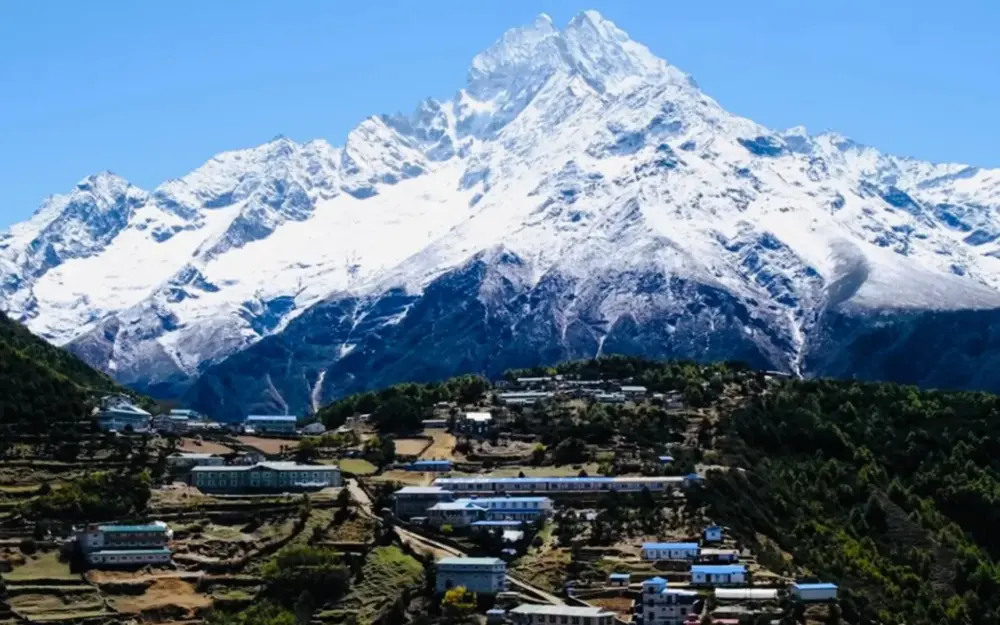
As you proceed through the trip, you will be in Sagarmatha National Park, a key conservation zone, with its natural beauty and mountainous landscape. The path leads steadily upwards and then grants you great views. In spring, the landscape is colorful due to the rhododendron forests. The last part of the day is a gradual rise to Namche Bazaar, which is the principal trade center in the Everest area. Namche Bazaar is at an elevation of (3,440 m / 11,286 ft), and the mountain views are all around, with the Bazaar providing a comfortable area to rest and acclimatize before proceeding higher into the Himalayas.
Today is an important acclimatization day in Namche Bazaar. You will start your gradual uphill walk to Everest View Hotel after having breakfast.
The trail also provides superb sights of the mountains around and gives your body time to get accustomed to the rising altitude. On arriving at the Everest View Hotel (3,820 m / 12,533 ft), you will take time to appreciate the view before going back to Namche Bazaar. The acclimatization is not that long but has a useful purpose in assisting to minimize the danger of altitude-related issues throughout the trek.
You can rest and have a look around Namche, and plan the next part of the trip. The next night at the same altitude will ensure that you are well acclimatized before travelling deeper into the Everest region.
Your trek will begin at Namche Bazaar and go to Deboche. The trail is a mountain track that has stunning scenery of the surrounding hills, monasteries, and snow-covered mountains. The path slowly takes you further into Namche as you leave Namche behind and move on to the Everest region.
On the way, you will travel through places that are considered to be of natural beauty and a calm environment. The scenery varies with the increase in your altitude, and the Himalayan setting is spectacular to see. Deboche is a small village between Tengboche and Pangboche, and it is marked by a monastery and a peaceful environment.
When you arrive at Deboche (3,820 m / 12,533 ft), you will be able to rest and have a view of the mountain. The location is a key rest point in the Everest Base Camp trail and a nice place to stay over before proceeding to greater heights in the coming days.
Today you are going to trek from Deboche to Pheriche. The trail passing Deboche, ascends slowly through the upper Khumbu. On the way will be Pangboche which is a permanent settlement at (3,985 m / 13,074 ft). The village boasts traditional culture and a mountainous environment.
The further up you go, the more open and rugged the landscape becomes. The perspectives of the nearby Himalayan mountains grow more and more impressive making it a memorable trekking experience. The trail then leads to the village of Pheriche (4,371 m / 14,341 ft).
Pheriche is a key destination for trekkers who are heading to the Everest Base Camp. The village is equipped with amenities that help travelers to adapt to the altitude. Once there, you will be able to relax and savor the scenic setting of the mountain. By staying here overnight, your body has more time to get used to it, and then the trek proceeds to even greater heights.
This is another acclimatization day which is aimed at making your body accustomed to the rising altitude. Instead of going directly to the Everest Base Camp, you will take the day to explore the hills surrounding the village of Pheriche and further add elevation before going back to the village.
The increase elevates you to about (4,700 m / 15,420 ft), giving you a chance to acclimatise gradually to the skinnier air. All day long, you may view the surrounding mountains and enjoy the quietness of the high Himalayan part. This low intensity will enable you to take a break and at the same time be active, which is a significant aspect of effective acclimatization.
You will finish the day at Phedre after having been up the mountain. This method is based on the rule of sleeping lower and climbing higher during the day and training you for the challenging days that are yet to come.
Today you trek from Pheriche to Lobuche. Abandoning Pheriche, the trail slowly ascends through mountainous terrain at high altitude. The higher one goes, the more rugged and dramatic the environment gets, and the more authentic Himalayan trekking one has.
The path also provides spectacular scenery of the nearby mountains and glacial landscape. Lobuche is linked with its neighboring Lobuche East and Lobuche West mountains that are frequented by climbers and trekkers. The mountain scenery is even more dramatic as you go towards the settlement.
On reaching Lobuche (4,910 m / 16,109 ft), you will be lodged in your lodge and will be allowed to take a rest. It is a significant camping place on the way to Everest Base Camp. A full day of rest and hydration will be the next step to the next part of the trek.
It is one of the most exciting days of the trek today. You will begin your trek at Lobuche and proceed to Gorakshep and then proceed to the ultimate destination of Everest Base Camp. This route utilizes rocky areas and trails next to the Khumbu Glacier into greater altitudes.
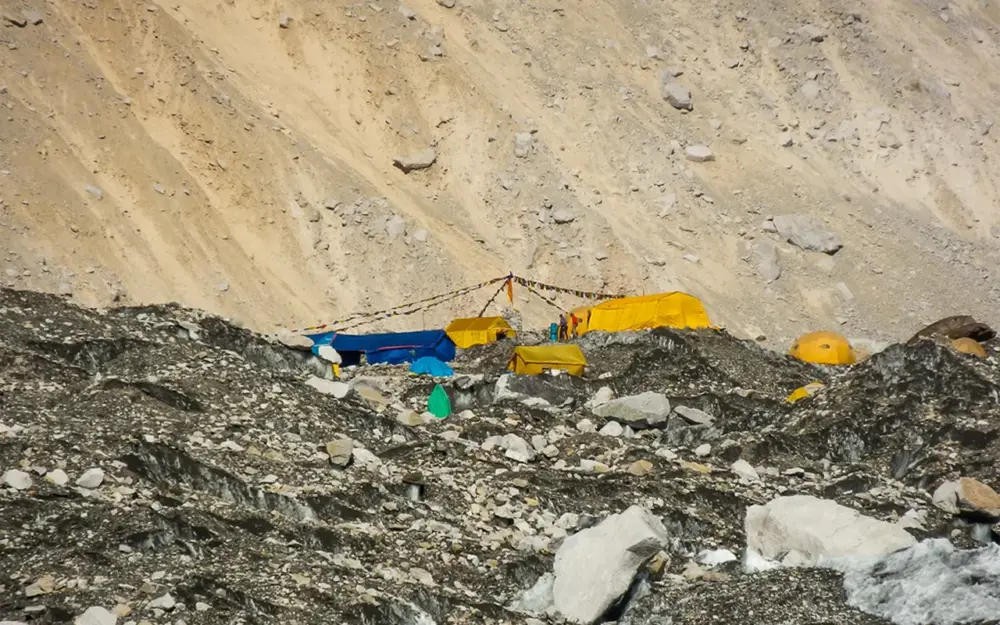
After reaching Gorakshep (5,165 m / 16,946 ft), you will continue onward to Everest Base Camp (5,364 m / 17,598 ft). Being at the foot of the highest mountain on the globe is a great experience and one of the greatest points of the trip. You can take your time in exploring the environment and absorbing the environment before you start the walk back.
You will go back to Gorakshep in the evening. You are then able to take a breath, relax, and have the last day in the Everest region after a long and fruitful day.
In the morning, you will hike up to Kala Patthar. This viewpoint is at (5,550 m / 18,209 ft) and has a panoramic view of Mount Everest and the surrounding Himalayan ranges. The mornings are a good time to appreciate the mountainous scenery.
You will have breakfast at Gorakshep after you have spent some time at Kala Patthar. This will be the last trekking exercise of the trip. After having breakfast, you will take a helicopter back to Kathmandu.
The helicopter flight allows one to have a distinct view of the mountains, glaciers, rivers, villages and monasteries within the Everest region. When you reach Kathmandu, you will check into your hotel, and after some days in the high mountains, you will have fun in the city. The rest of the day is at liberty to rest and relax.
Today is a free day in Kathmandu. Having had the adventure in the Everest region, this day is an occasion to relax and have a time of your own in the city. You can opt to stay at the hotel, visit various sections of Kathmandu, or shop and buy souvenirs and local products.
The day will enable you to think about the success of the trek and have a more leisurely day. There are numerous attractions in Kathmandu, and you can spend the time in the way you are interested in. The day is a relaxing prelude to your flight, whether you choose to go sightseeing in the city, go to local markets, or just rest.
During the evening, you will be able to do the last preparations for your trip home and make sure that all the arrangements have been made regarding the trip the next day.
The end of your journey is today. You will have ample time to make any last preparations after having breakfast at the hotel before leaving Kathmandu. A representative will subsequently take you to Tribhuvan International Airport at the right time to board a flight to take you away.
The trip to the airport is not long, and it offers one last chance to feel the air in the Nepal capital city. When your adventure is over, you will be able to reflect on the things that you have done during the period you spent in the Everest region, both in Kathmandu and the mountainous scenery around the Everest Base Camp.
In case you have more time to stay in Nepal, you can extend your trip and visit other places. Otherwise, you will continue with your foreign exit and will finish the journey with the unforgettable memories of the Himalayas.

You can cutomize this trip as per your requirements if met the proper guidelines.


The Everest Base Camp Trek with Helicopter Return is available to be done in various seasons of the year, although spring and autumn are the most favorable. The period between March and May is fairly steady and is characterized by blooming rhododendron forests and clear mountain views. The months of September through November are good, with pleasant weather, dry paths, and good visibility throughout the trek. Travelers can even venture off in winter, but the temperatures are much colder at higher altitudes.
The monsoon season gets a lot of rainfall, which may impact visibility and flight schedules. Himalayan weather is unpredictable, and thus one should always be flexible. The selection of the appropriate season may help to make the walk more comfortable and raise the probability of having clear weather during the trek.
This adventure involves a typical Everest Base Camp trek and a helicopter flight to Kathmandu. The overall trekking distance will be about 130 kilometers which varies depending on the specific path and side hikes on the acclimatization days. The journey begins in Kathmandu (1,300 m / 4,265 ft) and reaches Everest Base Camp (5,364 m / 17,598 ft). The peak of the journey is Kala Patthar (5,550 m / 18,209 ft), where the trekkers are able to view the magnificent scenery of Mount Everest and other surrounding mountains.
The slow climb gives time to acclimatize during the journey through Sherpa villages, forests, valleys, and high mountainous scenery. The helicopter return eliminates the necessity to travel the same path back, thus making the whole experience shorter and more convenient and yet with the key attractions in the Everest region covered.
Everest Base Camp Trek with Helicopter Return can be classified as a moderate to difficult trek. No climbing expertise is needed but the participants must be ready to walk over a number of days at high altitudes. The most difficult part is the altitude and not the trail. As the trekkers ascend above 3,000 m / 9,843 ft, the air becomes less dense and physical exertion can be more challenging. There are also proper acclimatization days to enable the body to adapt gradually.
Altitude sickness may have symptoms such as fatigue, shortness of breath, nausea and headache. Risks can be minimized by drinking a sufficient amount of water, walking at a moderate pace, and following the advice of the guides. When trekkers take enough time to acclimatize, a majority of the trekkers complete the mission successfully and have the marvelous views of the Everest area.
The number of walking hours differs during the trek based on the route, the terrain, and the altitude. Trekkers tend to cover three to four hours on less challenging days when they are going through acclimatization hikes. The trekking days may take up to eight hours in case of longer days to Everest Base Camp and back to Gorakshep. The average number of trekking days is five to seven hours of walking combined with rest intervals, meals and photography.
The paths consist of gentle slopes, steep slopes, suspension bridges, and mountain tracks. Speed at higher altitudes is not as important as a steady pace. The itinerary aims at giving a balanced progress to Everest Base Camp and giving time to acclimatize. Adherence to the set timetable will assist trekkers to sustain their energy levels and get used to the fluctuating altitudes comfortably.
Overnights on the trek are mainly in teahouses and mountain lodges locally. The rooms are most often plain yet cozy, a homely place to sleep after every day of trekking. Accommodation will be offered in Kathmandu, prior to and after the trek. As part of the trekking process, meals are typically breakfast, lunch, and dinner. The typical dishes are rice, noodles, soup, potatoes, vegetables, eggs, bread, and local and international cuisine.
Most lodges serve hot beverages like tea, coffee, and hot lemon. Drinking water can also be bought along the way i.e bottled water and boiled water. With the rise in altitude, the food options are a little more restricted, though trekkers can still have healthy meals, which will sustain them on the journey.
The Everest region can be linked with several other destinations that can be used by travelers who want to have an alternative experience. Other trekkers visit Gokyo Lakes that have beautiful turquoise waters and mountainous scenery. Others continue their trek by the Cho La Pass to have a more difficult adventure. Everest trekking routes are also shorter, with the emphasis on Namche Bazaar and Everest View Hotel.
The Everest Base Camp Heli Return Trek has been more popular since it enables the trekkers to get to the main destination and save many days in the process of returning. The helicopter flight gives a special glimpse of glaciers, valleys, and mountain scenery. Both paths have their positive sides, and the traveler has the chance to select an experience that can fit his/her available time, interests and fitness level.
Yes, beginners can take part in this trek provided that they are ready to spend several days walking in the mountains. Experience in trekking is desirable but not necessary. Positive attitude, decent fitness, and readiness to adhere to the itinerary are the most essential requirements. Beginners need to know that climbing higher may be physically exhausting, though the distances to be covered every day are moderate.
The route has acclimatization days, which allow participants to adapt slowly to the altitude. Pre-trip walking and cardiovascular fitness can help enjoy the experience. Through proper preparation, most first-time trekkers manage to make it through the trek. The support staff and professional guides are also instrumental in offering support during the trek so that the participants can navigate through the Himalayas safely and fearlessly.
The trekking experience can be greatly enhanced by prior preparation. It is suggested that prior to departure, one should start fitness training several weeks prior. Endurance and strength can be developed through activities like hiking, walking, jogging, cycling and stair climbing. Exercise above the heart makes it simpler to manage lengthy trekking days as well as fluctuating altitudes. Trekkers ought also to get acquainted with their equipment before traveling to Nepal.
Appropriate attire, good trekking shoes and backpack will help to make the journey more comfortable. Mental training is also critical since the weather and the difficulty of the trail may be different. Helicopter Return Everest Base Camp Trek also has acclimatization days, which assist in adjusting gradually to the altitudes, though personal preparation is also a significant aspect of successful completion of the trek.
Most of the teahouses along the trekking route have charging facilities, but at the higher altitudes, one is likely to be charged a small fee. It is advisable to bring a power bank, particularly when on long trekking days. In most villages, we can get mobile network connection, but the signal may become weaker at higher altitudes. There are also several lodges that have internet access through local WiFi services. The quality of connections differs with the location and weather conditions.
Travellers carrying their electronic devices to take photos, communicate or get directions should make arrangements. Warming up the devices in cold weather also prolongs battery life. Although there are numerous areas with internet connectivity, the hike also provides a good chance to forget about all the everyday things and admire nature.
There are several permits that trekking in the Everest region requires. The Sagarmatha National Park Entry Permit and the Khumbu Pasang Lhamu Rural Municipality Permit are required by the trekkers. Such permits are used to aid conservation and community development in the area. Checking on permits is done at different stages of the trail. Trekkers must always carry their documents during their trek.
The majority of the organized trekking packages cover the necessary permits before the trek, and therefore the participants find it easy to do so. The requirements for permits might also vary over time, and therefore it is always best practice to ensure the existing regulations are checked before travelling. With the right permits, it will guarantee a hassle-free trekking experience, and the visitors will be able to explore the Everest region legally and responsibly.
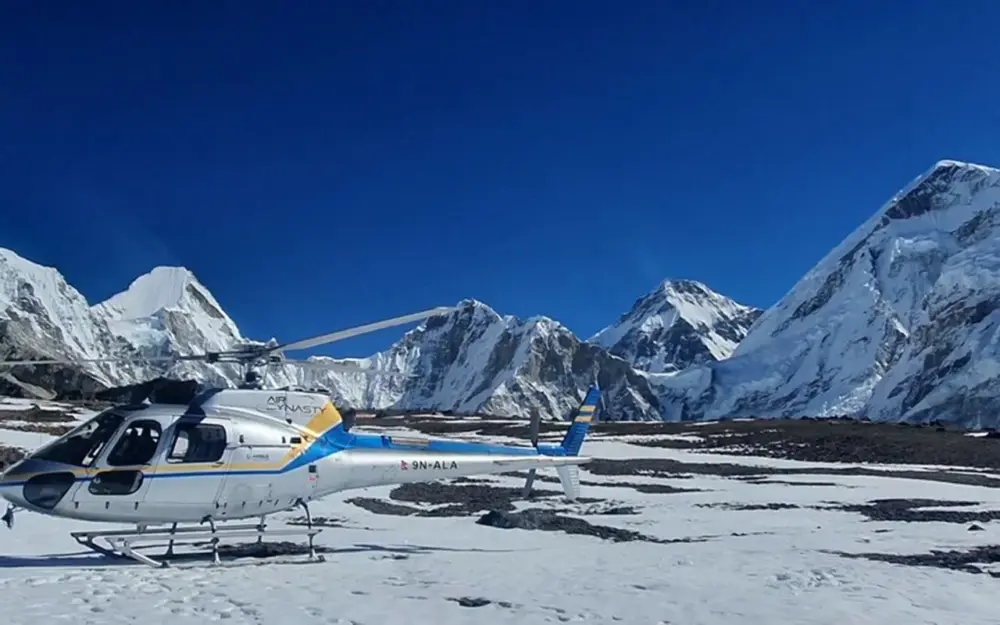
Transportation includes airport transfers, domestic flights, and the helicopter return service. The trek starts with an arrival in Kathmandu and a flight to Lukla, the entrance point to the Everest region. The flight provides breathtaking scenery of the hills, valleys, and mountainous terrain. Participants go back to Kathmandu by helicopter after the trek is completed and they arrive at Kala Patthar. This is one of the key aspects of the trip since this is a fly-back.
It offers spectacular view of the glaciers, the mountain, rivers, and villages all at the same time as one is flying. The helicopter flight also removes a number of days of walking back to Lukla. Mega Trek provides the required transport services so that the travelers do not have to bother about transportation logistics, but rather enjoy the trekking experience.
All the participants of this trek are highly encouraged to purchase travel insurance. There should be an appropriate policy regarding high altitude trekking and emergency helicopter evacuation in case. Other areas to be covered include medical treatment, delays in trips, lost luggage, and unforeseen delays in travelling. The weather in the Himalayas is unpredictable, and insurance is an added advantage throughout the trip.
To cover the trekking activities beyond (5,000 m / 16,404 ft), the traveler needs to carefully read the policy details and ensure that the trekking activities are covered. It is advisable to carry evidence of insurance on the trek. Proper coverage will give them a sense of security and allow travelers to deal with emergent problems that could occur on their adventure in the Everest region.
This adventure is a blend of mountain hiking, culture, and a scenic helicopter ride back, all in one adventure. Trekkers will also be able to enjoy beautiful scenery, traditional Sherpa villages, suspension bridges, forests, glaciers, and sightseeing of some of the highest mountains in the world. The path will slowly approach Everest Base Camp (5,364 m / 17,598 ft), and time is given to acclimatize. On their way, the visitors get to witness the special life and hospitality of the Khumbu region.
The climax of the journey is arriving at the Everest Base Camp and then having panoramic views of the mountain at Kala Patthar. This journey is topped off by a spectacular helicopter flight back to Kathmandu. This adventure is time-saving and rewarding as the participants are on a trek and aerial sightseeing at the same time.
Spring and fall are generally the most stable and clear on the mountain.
The journey is moderate/challenging due to the elevation and several days of walking.
No, but it helps to be fit and prepared.
The highest point is Kala Patthar at (5,550 m / 18,209 ft).
Mild symptoms might be felt by some trekkers; that is why acclimatization days have been incorporated.
During the trek, accommodation in Kathmandu hotels and in teahouses is offered.
Yes, there are vegetarian food options along the route.
Yes, most lodges have charging facilities at an extra fee.
Internet can be accessed in most of the villages, but not all have a good connection.
The Sagarmatha National Park Permit and Khumbu Pasang Lhamu Permit are needed.
Mountain flights can be influenced by weather conditions, and sometimes itinerary changes can be required.
Yes, high altitude trekking and emergency evacuation insurance is strongly advised.


 Write a Review


