
Talk To Expert
Mail Us

Trip Duration
13 Days
Group Sizes
2 to 25 People
Difficulty
Moderate
Max. Altitude
4984 m
Activities

Meals

Accommodation
The Langtang Gosaikunda Trek is a very fulfilling trek in Nepal, as it offers breathtaking Himalayan views, mountain culture, sacred alpine lakes and thrilling high-altitude routes all in a single memorable experience. The walk is ideal for those who want to enjoy a wide range of Himalayan experiences, which is a combination of nature, adventure and cultural exploration. With Mega Treks, this adventure is a systematic and enjoyable adventure through one of the most scenic trekking areas in Nepal.
The trek starts with scenic forest trails, traditional villages, and river valleys in the serene Langtang region, which forms a beautiful start to the trek. As you ascend, the scenery is changing slowly to a dramatic outlook of the alpine landscape with snow-capped mountains. A Langtang Gosaikunda Trek itinerary, which is well planned, will enable the trekkers to enjoy the varying beauty of the region and still have sufficient time to acclimatize.
A significant attraction of the trek is the arrival at Kyanjin Gompa (3,870 m / 12,697 ft), a picturesque mountain village held by glaciers and the towering Himalayan peaks. To be even more adventurous, the acclimatization hike to the Tsergo Ri at (4,984 m / 16,352 ft) can be regarded as the panoramic mountain views worth the effort.
The journey is then made towards the sacred Gosaikunda Lake area in Nepal, which is among the most spiritually significant alpine sites in Nepal. Gosaikunda (4,380 m / 14,370 ft) is a sacred pilgrimage place with crystal-clear lakes and a beautiful mountainous location. A further thrilling adventure is the possibility of crossing Laurebina Pass (4,610 m / 15,125 ft), which rewards trekkers with high-altitude drama.
The Langtang Gosaikunda Trek is also a good cultural experience based on traditional tea house accommodation, local hospitality, and experience with the Tamang mountain people. This trek is so unique due to the scenic beauty, adventure, spirituality and cultural immersion.
The hike is best suited to active travelers who are ready to spend several days walking in the mountains and shifting altitudes. This Himalayan adventure is a safe, fulfilling and very memorable experience in Nepal, with the correct preparation and encouragement of Mega Treks.
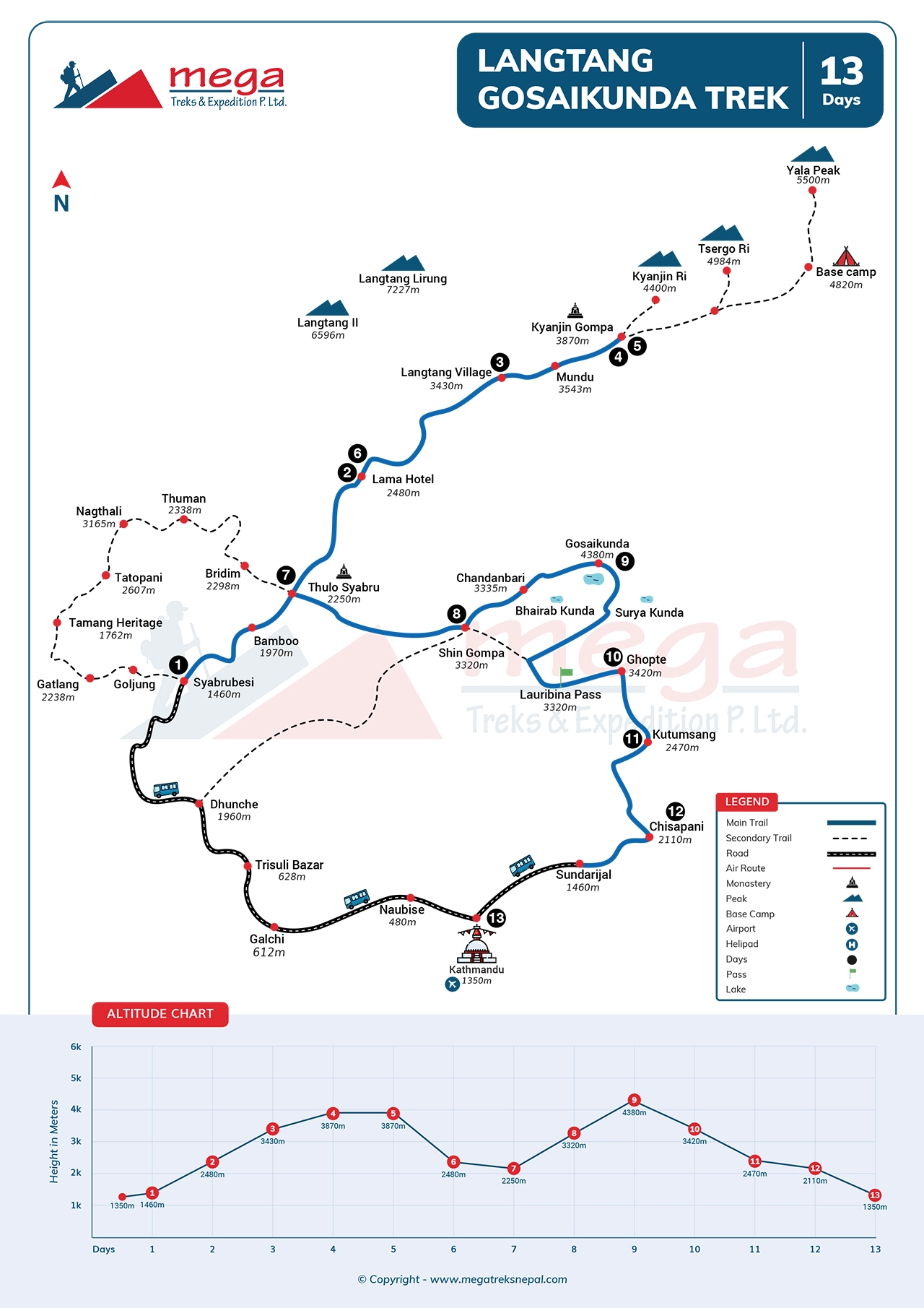
The Langtang Gosaikunda Trek starts with the picturesque view of Kathmandu to the starting point of the trekking journey, Syabrubesi. Leaving the busy city, the road goes across the beautiful countryside landscapes, terraced farmlands, traditional villages, and winding mountain roads along with the Trishuli River. This is a long, scenic drive, which is a wonderful introduction to the natural beauty of Nepal and the rural life of Nepal.
Once they arrive at Syabrubesi (1,470 m / 4,823 ft), trekkers spend the night gearing up for the trek that follows. The next day, the real trekking starts by entering the National Park Langtang by following calm forest trails with Rhododendron, bamboo, and oak trees. The initial part of the walk is beautiful and invigorating, slowly taking one further into the Langtang Valley and preludes the mountain experience to come.
Your trek will start today with a picturesque drive from Kathmandu to Syabrubesi, where your trekking adventure will begin. On abandoning the bustling streets of Kathmandu, the road leads you through picturesque landscapes of countryside, terraced farms, traditional villages, and winding mountain roads. The Trishuli River is also located on the right of the road during most of the trip, which also contributes to a more pleasant drive.
It will have some occasional stops in between to have tea, refreshments, and lunch. At Dhunche, the issue of the permit to enter Langtang National Park will be done before moving on. The road is more mountainous, and the air is fresher as the journey goes on. This motivation is a marvelous preview of the natural beauty of Nepal prior to the trek.
After around 6 to 8 hours, you will arrive at Syabrubesi at (1,470 m / 4,823 ft). Once you have been checked into your hotel, you have time to relax, pack your trekking gear, or go sightseeing around the small village before your trek starts tomorrow.


You will be starting the trek from Syabrubesi to Lama Hotel today. The trail begins with a bridge after breakfast and into the beautiful forested paths of Langtang National Park. You walk along through a forest of rhododendron, oak, and bamboo trees, with the peaceful sound of the Bhote Koshi River.
Most of the day, the trail leads uphill gradually, so it is a moderately difficult beginning of the trek. You can take short breaks, have tea, and rest your legs along the route at various small tea houses along the route. The farther you go into the forest, the more pronounced the silence and tranquility are.
It will take approximately 5 to 6 hours of walking to reach Lama Hotel at (2,400 m / 7,874 ft). This little pit is in the middle of the forest, where you can have a simple yet comfortable accommodation in a trekking lodge, where you can rest and prepare for the next day.
Today, we will be trekking from Lama Hotel to Langtang Village and further into the beautiful Langtang Valley. The day starts after breakfast with an uphill climb on forested tracks, after which the path becomes easy. The trees start to thin out, and the amazing mountain views begin to emerge as you ascend.
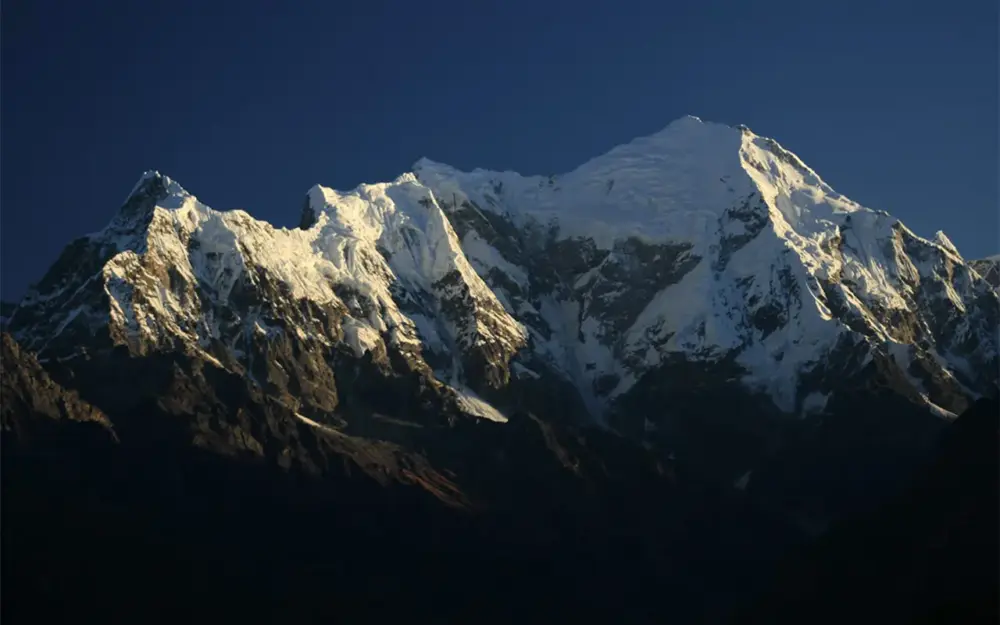
The first clear sight of Langtang Lirung is one of the attractions of today that ascends beautifully above the valley. At Ghodatabela, which was formerly a horse stable, you will have lunch. Other wildlife you can also see along the trail include monkeys, deer, and Himalayan thar.
On your way to your destination, you will drive by the ruins of the old Langtang Village, which suffered a severe hit during the 2015 earthquake. The reconstructed Langtang Village is at (3,450 m / 11,319 ft) and is equipped with good tea houses, breathtaking views, and an opportunity to feel the life in the local mountain village.
Today, you are going to trek from the Langtang Village to Kyanjin Gompa, which is considered to be one of the most beautiful places on the trek. The walks in modern times are shorter in length, but the rise in altitude may make the hike seem difficult. It is advisable to start early since it is known that the afternoon winds are strong in this area.
The track goes through a village, Mondu, and then moves on to a more open mountain road. You will find prayer rocks, rocky terrain, and probably yaks grazing along the way. The mountain landscape is even more breathtaking as you climb up the mountain, with each stride being well worth it.
Once you get to Kyanjin Gompa (3,870 m / 12,697 ft), you will be able to check in at your trekking lodge and have lunch. You can visit the local monetary and cheese factory later. During the evenings, you can hike to Kyanjin Ri to get breathtaking sunset scenes as you gaze at the Himalayan mountains surrounding it.
Today is your acclimatization day at Kyanjin Gompa, where your body can adjust to a higher altitude and, at the same time, be active. You will not sleep fully, but instead you will climb to the highest point of this trek, which is Tsergo Ri, and is at (4,984 m / 16,352 ft).
Your early breakfast will be to start the steep climb to the summit. As the journey will not have tea houses above Kyanjin, a packed lunch will be carried. It is a physically challenging climb, but when you get to the top, you can see the mountain, and the panoramic views of the mountain make it worthwhile. The Himalayan vistas are memorable everywhere, with stunning views to the north, south, east, and west.
You will then spend the night at Kyanjin Gompa after having spent some time at the top. Once again, you can take a warm beverage, have a nice dinner, and sleep after working hard and a fruitful day in the mountains, going back to the lodge.
Today will bring you trekking back from Kyanjin Gompa to Lama Hotel, following the same route you followed to Kyanjin Gompa, across the beautiful Langtang Valley. Having already completed the high-altitude part of the trek, the journey of today seems less difficult since most of the trail is down.
You will pass known sceneries, mountain towns, and vistas, leaving Kyanjin Gompa behind. On your route, you can make a stop at such places as Mondu or Langtang Village to have a tea or a little rest. You can also taste the sea buckthorn juice, which is a favorite in this area, should there be any.
The mountain views gradually change to thick forests as you move downwards. The walk is pleasant, even though the hours of trekking are very long, due to the fresh mountain air and calm environment. In some 5 to 6 hours, you will be back at Lama Hotel at (2,540 m / 8,333 ft), where you can relax and prepare for the next part of the adventure to Gosaikunda.
Today you are going to walk out of Lama Hotel in the direction of Thulo Syabru, you are leaving the trail of the Langtang Valley, and starting the second part of the journey, the Gosaikunda. You will follow, after breakfast, many of the old tracks of the previous route, with all the old wood lanes and water courses. The initial section of the trek is less difficult since you are walking down and down to the lower parts, and then at the crossroad, where the track takes a different direction.
Once you arrive at Pahiro, you will follow another path that will lead you to Thulo Syabru. Here, the trek gets more difficult with mountainous climbs through green trees and mountain trails. You will pass over a suspension bridge on your way and will be in a serene environment of trees and cool mountain air.
A few hours of walking will bring you to the beautiful village of Thulo Syabru at (3,620 m / 11,877 ft). This rural mountain village has fine tea houses, scenic landscapes, and a serene environment where you can spend the night.
Today you are going to walk across Thulo Syabru to Shin Gompa and formally enter the Gosaikunda trail. The days of trekking now are shorter and not as demanding as before, and you are able to walk at a comfortable pace and enjoy the beautiful surroundings around you.
The path ascends gradually through a quiet woodland of oak, pine, and rhododendron trees. In spring, the rhododendrons bloom, and it is even more pleasant to walk in the landscape with the bright colors created by them. As you continue to climb in altitude, you start experiencing wonderful mountain scenery, not to mention spectacular views of Ganesh Himal.
The trail is serene and picturesque, and is an enjoyable day of trekking. About 4-5 hours of walking will bring you to Shin Gompa or Chandanbari at (3,330 m / 10,925 ft). It is a small village with a peaceful monastery and a local cheese factory. Once you have checked into your tea house, you can use the rest of the time to explore the area and relax.
You will have a walk today from Shin Gompa to Gosaikunda, one of the main attractions of the whole trip. This is a special day as you make your way toward one of Nepal’s most sacred alpine lake areas. The path ascends gradually up through the scenery of the taller mountains, and grows more open and theatrical with the height.
As you ascend, the landscape will change to rugged alpine terrain, where you will see amazing mountain views. Gosaikunda is not only spiritual, but also ecological in nature because the lake system is declared a significant wetland area. This holy place is visited by numerous pilgrims every year.
When you arrive at the top of Gosaikunda (4,380 m / 14,370 ft), you will be treated to the amazing sight of the beautiful lakes with mountains all around them. Close by sacred lakes like Saraswati Kunda and Bhairab Kunda may also be seen. You will spend the night in the lodge after a tedious day of trekking and enjoy the tranquil mountain environment.
Today, you will be trekking from Gosaikunda to Ghopte by crossing the high Laurebina Pass, one of the most challenging and exciting days of the trek. You can start climbing to the pass in the mountainous paths of rocks and spectacular alpine scenery after an early breakfast.
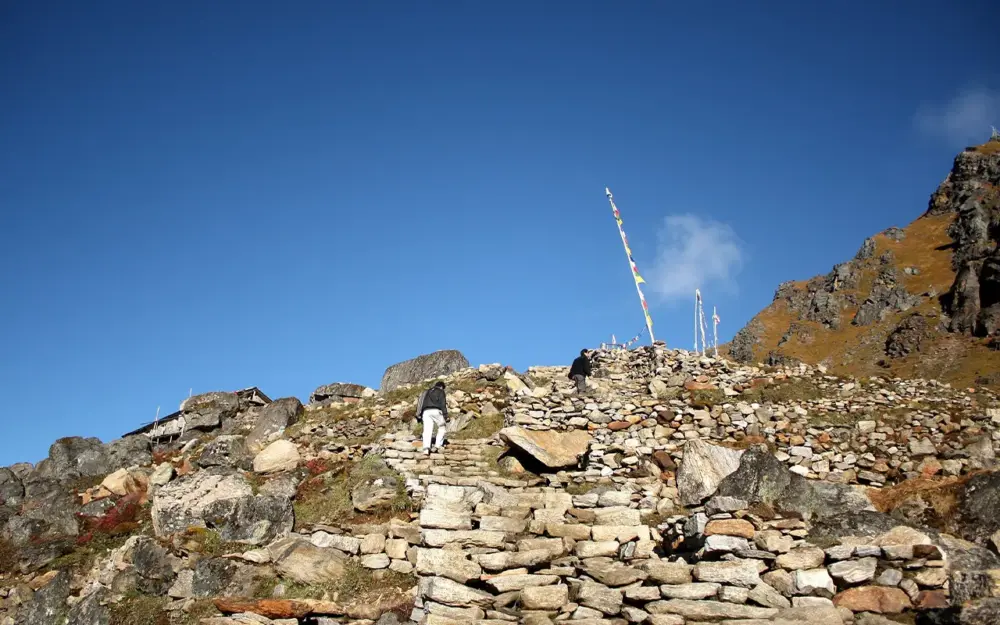
The ascent is strenuous and physically challenging, yet with each step, the breathtaking Himalayan view becomes a reality. It is a significant accomplishment to reach Laurebina Pass at (4,610 m / 15,125 ft). Prayer flags and chortens adorn the top to give it a classic Himalayan mountain pass feel. Here you start to leave the Langtang area and enter the Helambu one.
Once having seen the amazing scenes, the path leads to Ghopte, with fewer sounds of the mountains. The downward side is also exhausting due to the arduous climb, but the views are worthwhile all day long. A complete day of walking will bring you to the little village of Ghopte, where you can stay in a local tea house.
Today we will walk out of Ghopte, up to Kutumsang, through some beautiful forests and high mountain ridges. Following the difficult pass over the last day, the trail today seems easier, but there are still some ascents and descents to be made.
The trail traverses juniper, oak, and rhododendron forests, and provides a serene hiking experience. A significant stop on the modern trail is Tharepati (3,650 m / 11,975 ft), where you get to see a clear view of the mountains in the Helambu region. Here, the path slowly winds down through lonely mountain-tracks and isolated villages.
You will pass along the way to Magen Goth, and then you will be close to Kutumsang. In a few hours, you shall reach this mountain village and spend the night in your lodge. This is a nice place to rest and have a good sleep, as the journey is going to be less demanding in the time ahead.
It’s Kuthumsang to Chisapani today, following the picturesque paths of villages and quiet trails. Once you have taken breakfast, you start to descend, having a view of the spectacular scene, which includes the amazing sight of the Dorje Lakpa in the far distance.
The trail goes through the villages of Gul Bhanjyang and Pathi Bhanjyang, where you can have tea and lunch. On your drive, you will observe grazing fields, meadows, farmland, and local villagers going about their daily business. Today is less straining and culturally enriched as compared to the high mountain areas of the trek.
The path goes amidst a serene natural environment up to Chisapani (2,300 m / 7,546 ft). The 2015 earthquake hit this village, but since then, it has been reconstructed, and the lodges that received trekkers are functioning again. Once there, you will be able to rest and spend the last night in the hills before going back to Kathmandu.
In the morning, you will continue your adventure by walking out of Chisapani to Sundarijal and then driving back to Kathmandu. Following your breakfast, you start with the last walk through quiet forest paths as you gradually part with the mountain setting.
This is an interesting last trekking day since the trail goes through Shivapuri National Park, and you get to experience another preserved natural habitat. The walk is not as hectic or demanding as it used to be in the past trekking days, hence you have time to take the remaining part of the walk at your own pace.
In about three hours of walking, you will reach Sundarijal at (1,350 m / 4,429 ft), and the trek will be officially terminated. It is here that you will drive back to Kathmandu, back to the bustling city after a couple of weeks in the mountains. This is the culmination of a wonderful exploration of gorgeous landscapes, mountain life, and treks to remember.

You can cutomize this trip as per your requirements if met the proper guidelines.


The best time for the Langtang Gosaikunda Trek is during spring (March to May) and autumn (September to November). The seasons normally provide a predictable weather, good mountain sightseeing, and easy trekking. The woods on the trail are in full bloom in the spring with rhododendrons, and the walk is beautiful. Autumn is also a favorite season as the monsoon generally clears up after, and the Himalayan peaks can be seen well.
It can be trekked in winter but higher places like Gosaikunda and Laurebina Pass may get a lot of snowfall, and thus the path will be more challenging. The monsoon season is characterized by rain, slippery paths, and a small mountain scenery.
When planning your Langtang Gosaikunda Trek itinerary, spring and autumn are usually the most sure bets. These seasons offer the most favorable weather, landscape, and trail conditions, making the entire trekking experience safer, easier, and more pleasurable.
The Langtang Gosaikunda Trek is an enriching Himalayan adventure that incorporates valley adventure, holy lakes, and mountain passes. The entire trekking range would sum up to around 130-150 kilometers of hiking distance, depending on the specific path and hiking extensions involved. This renders it a fairly long trek that trekkers can take to have a full mountain experience.
The trek starts at (1,470 m / 4,823 ft) at Syabrubesi, and the highest trekking point is at Laurebina Pass at (4,610 m / 15,125 ft). With the acclimatization hike up to Tsergo Ri, the highest point is (4,984 m / 16,352 ft).
Due to this high gain in elevation, it is necessary to be properly acclimated. The path is a mixture of slow ascending, sharp uphill, and protracted downhill. The cost of the Langtang Gosaikunda Trek may be affected by the route distance and additional acclimatization days, and this means that the final package price may vary.
The Langtang Gosaikunda Trek can be classified as a moderately demanding to a difficult trek. It includes multiple days of uphill walking, hours of trekking, and crossings at high altitudes. No technical climbing is needed, but good physical fitness will help to complete the journey comfortably.
One of the major concerns is altitude sickness since the trek goes up to higher altitudes of over 4,000 m / 13,123 ft and the Laurebina Pass of 4,610 m / 15,125 ft. Symptoms can also be common, such as headache, tiredness, nausea, poor sleep, or shortness of breath.
In order to minimize the risk, one should go through appropriate acclimatization, constant walking speed, hydration, and sufficient rest. The acclimatization day at Kyanjin Gompa assists your body to get acquainted before proceeding on an elevated plane.
This trek is not to be underestimated, and most healthy trekkers can accomplish it with proper preparation. Knowing about the physical requirements can guide you to prepare better for the entire Langtang Gosaikunda Trek itinerary in the future.
The Langtang Gosaikunda Trek comprises both short and longer trekking days, providing you with a balanced adventure. On less strenuous days, like the one between Langtang Village and Kyanjin Gompa, you can walk up to 3 to 4 hours. More difficult and longer days of crossing Laurebina Pass or walking to Gosaikunda might take 7 to 8 hours based on the pace, weather conditions and trail conditions.
The average trekking days have 5-6 hours of walking. The precise distance also fluctuates, normally 7-21 kilometers daily. There are days with gradual ascents, and there are days with steep ascents or with long descents.
The diversity of the walking time makes the walk intriguing, yet physically challenging. When glancing over an itinerary of the Langtang Gosaikunda Trek, one should be aware that the time spent on the trail may vary slightly, contingent on the condition of the trails, acclimatization requirements, and the speed of the group walking.
The Langtang Gosaikunda Trek is primarily accommodated in the local tea houses and trekking lodges. They are basic, yet comfortable, and offer simple rooms with beds, blankets, and shared bathroom facilities in most locations. Lower villages tend to have better facilities, whereas higher areas have less elaborate facilities.
Food is usually nutritious, hot, and trekking food. Popular dishes are dal bhat, noodles, fried rice, soup, potatoes, eggs, pancakes, bread and basic snacks. Commonly available are tea, coffee, hot lemon, ginger tea, and bottled or boiled water.
Food options could be reduced as you rise in altitude, and the prices can tend to be higher since supplies are transported to isolated locations. Mega Treks assists in making arrangements for accommodation and meals in a smooth way so that the trekkers can concentrate on the journey. Proper nutrition and hydration will enable one to finish the trek safely and comfortably.
Langtang Gosaikunda Trek can be tailored based on your schedule, fitness, and trekking objectives with various route options. There are trekkers who do the Langtang Valley only, and others who do the Gosaikunda route only, and want to spend a shorter period in a pilgrimage-like experience.
The other common variant is an extension of the trip to Laurebina Pass, then to the Helambu region, thus making the trip a more varied and longer trekking experience. Side hikes like Kyanjin Ri or Tsergo Ri are also included in some of these itineraries to get additional mountain sightseeing.
These alternative ways can influence the number of walking days, the level of difficulty, and the cost of the Langtang Gosaikunda Trek. The short ones are applicable to those who do not have much time, whereas the long ones will provide a complete Himalayan experience.
The right route is determined by the time you have and the kind of trekking you prefer, and all the variants provide stunning mountain views, local culture and fulfilling trekking experiences in the Langtang region.
Yes, first-time visitors can participate in the Langtang Gosaikunda Trek, although they must be fairly fit and ready to handle the physical challenges of high-altitude trekking. It is not a beginner trek since it consists of several long walking days, steep ascents, and heights greater than 4,000 m / 13,123 ft.
When you are not a trekker before, it is essential to be well prepared. Pre-trip exercise, which is in the form of regular walking, climbing stairs, light cardio, and endurance training, can make the trek very easy. Beginners are also advised to know about altitude sickness and to be prepared to walk slowly and steadily.
Safety and comfort are significantly enhanced by a well-thought-out Langtang Gosaikunda Trek itinerary with appropriate acclimatization. Guided trekking is also very beneficial to first-time trekkers, because they will be accompanied throughout the trek.
When armed with the correct attitude, physical training, and proper expectations, motivated beginners can easily make it through this trek and have a trip to the Himalayas that they will remember forever.
The Langtang Gosaikunda Trek should be prepared well in order to have a safe and comfortable trek. As the trek involves several long walking days, steep ascents, and high altitude, it is highly suggested that you develop physical fitness before arriving.
A few weeks of preparation can make a big difference. Frequent walks, hiking, using stairs, bicycling, jogging, or cardio exercises can be used to enhance stamina and leg strength. Concentrate on the stamina because trekking needs consistent energy for numerous hours.
Preparation of the mind is also essential. Weather on the mountain, primitive accommodation, trail conditions, and physical fatigue are all typical aspects of the experience. Carrying the appropriate trekking equipment, warm clothing, heavy boots, and personal essentials keeps you cozy, too.
Although you are active, it can still feel difficult at the top (4,000 m / 13,123 ft) despite being active. Proper preparation enhances confidence and fun during the process. An orderly hike will enable you to pay more attention to the scenery and experience than to physical pain.
When walking the Langtang Gosaikunda Trek, it is possible to charge your electronic devices and use internet services in most villages, but as you head higher and more remote, the services become less common. Lower trekking halts tend to have phone, camera, and power bank charging facilities, usually at an additional charge.
Wi-Fi is occasionally used in tea houses to access the internet in bigger villages, although the connection may be slow or unreliable. In certain areas, mobile network connectivity can be fine, but the signal strength can differ depending on the area.
Since not all places have the opportunity to charge, it is highly advisable to have a fully charged power bank. Batteries can also be depleted at higher rates due to cold temperatures.
In case it is significant to be able to stay in touch with something, it is careful to think ahead. Instead, many trekkers choose to be out of touch with the world and enjoy the mountain setting. Simple communication is normally a possibility, although quick and reliable internet on the entire trekking trip is not to be expected.
The Langtang Gosaikunda Trek requires trekking permits before entering the guarded trekking spots. As the path goes through Langtang National Park and designated trekking areas, all trekkers need valid permits.
Depending on the existing trekking policies, the most requested ones are the Langtang National Park Entry Permit and the TIMS (Trekkers Information Management System) card. The permits are used to control tourism and to conserve and enhance the safety of trekkers.
Checks are made at specific checkpoints along the path, and it is therefore required to carry the documents during the trek. Access might not be granted without proper permits.
In trekking with a professional company, such as Mega Treks, the permit logistics are normally taken care of ahead of time, and it is much simpler and more comfortable. The price of permits is usually covered in most trekking packages; it varies with the particular reservation.
It is a good idea to get all paperwork in order before heading off on the trek so that the first day of the adventure can be stress-free.
The Langtang Gosaikunda Trek is typically organized with transport starting with an overland journey from Kathmandu to Syabrubesi, the base of the trek. This trip takes approximately 6 to 8 hours, depending on road and traffic conditions. The route provides picturesque rural landscapes, rivers, mountain passes, and quaint villages.
By the end of the trek, transport is often organised between Sundarijal and Kathmandu, approximately one hour by road. This provides an easy circular hiking path, without having to go back to the same path.
The mode of transportation can be taken by public buses, shared jeeps, or personal vehicles, according to the budget and trekking plans. Privacy in transportation is more comfortable, whereas public ones are cost-effective.
The cost of transportation may have a minor impact on the total Langtang Gosaikunda Trek price, and this is in cases where personal transfers are favored. Planned trekking tours tend to be inclusive of the necessary means of transport, making the logistics of traveling to Nepal easier for the trekker who comes to Nepal to go on their mountain tour.
Anyone who is taking part in the Langtang Gosaikunda Trek is highly advised to take travel insurance. As this trek takes one to far mountainous locations and high altitudes above (4,000 m / 13,123 ft), having adequate coverage comes with a valuable sense of relief.
The best insurance policy must cover emergency medical care, high altitude trekking, evacuation, trip interruption, as well as lost baggage coverage or delayed travel. In Nepal, helicopter evacuation may be costly, and it is crucial to pay attention to this coverage.
Even seasoned trekkers may experience unforeseen weather conditions, sickness, elevation-associated issues, or slight injuries. The insurance will minimize financial risk in case of emergencies.
Always ensure the altitude coverage of the policy before booking, because some policies do not cover trekking above a specific altitude. It is essential to read the details carefully. Although nobody anticipates issues during the expedition, the presence of good travel insurance is a sensible and prudent aspect of planning a trekking adventure in the Himalayas.
The Langtang Gosaikunda Trek is a perfect Himalayan trekking adventure that will provide the opportunity to experience the mountainous landscape, the local culture, the sacred lakes, the forest paths, and the high mountain passes. This hike will be perfect for those who desire to enjoy the beauty of nature and the culture in a single adventure.
Peaceful village, rhododendron forest, suspension bridges, alpine scenery, glaciers, monasteries, and memorable mountain views are some of the things you should expect. The sacred Gosaikunda Lake provides a spiritual touch, and the crossing of the Laurebina Pass provides adventure and challenge.
The trip consists of basic tea house lodging, local cuisine, fluctuating climate, and strenuous hiking days. Increasing altitudes where the air is thinner may cause trekking to be more difficult, although correct pacing and acclimatization can be useful.
In a comparison of the routes, the Langtang Gosaikunda Trek itinerary has a very good range of diversity in a trip. To trekkers who want to experience the scenic diversity, cultural exposure, and a mountain adventure that is rewarding, this trek offers a highly satisfying and memorable experience in Nepal.
Yes, skilled solo trekkers are capable of doing this trek; however, a guide is hired to ensure more safety, direction and local guidance.
The presence of a guide is not essential, but it is safer, easier and more enjoyable to have a guide to assist in the journey, and more so at higher altitudes.
Bring enough Nepalese cash to spend on personal costs like drinks, snacks, Wi-Fi, charging, hot showers and tips because card payment is not a common option.
No, there are no reliable ATM services on the trekking path, and thus, before the trek, it is better to withdraw cash in Kathmandu.
There are numerous places in Kathmandu where you can rent or purchase trekking equipment such as sleeping bags, jackets, trekking poles and backpacks.
Yes, there are bottled water, boiled water and refill stations in most tea houses on the trekking route.
The majority of tea houses offer shared, simple toilets. The facilities tend to be simple in higher and more remote locations.
Yes, vegetarian food is very common and vegan food might be available, but the choices are less diverse in the higher altitudes.
The schedule can be changed or postponed in case the weather is unfavorable and in places with high mountains.
There are only a few laundry options and therefore, many trekkers use quick-dry clothes and wash smaller ones manually.
Depending on the season and the state of the trail, you might see monkeys, Himalayan thar, deer, mountain birds, and other wildlife.
Yes, you can usually tailor-made private trekking itineraries according to your schedule, health, and travel plans.
Carry a personal first aid kit, painkillers, blister pills, altitude sickness medication and a personal first aid kit.
In certain villages, there is a mobile network, but it gets weaker or inaccessible in remote and high-altitude areas.
Yes, high-altitude trekking and emergency evacuation coverage of the travel insurance are highly advisable for safety reasons.
The most favorable seasons are spring and autumn, when there is a clear view of the mountains, the weather is stable, and the trekking is easy.
This is a moderate to challenging trek because of the long walking days, steep ascents, and elevated altitudes.
The average time spent walking on most trekking days is 5-6 hours, with longer days having 7-8 hours on average.
Yes, novices who are well-fitted, well-prepared, and in their right frame of mind can complete this trek.


 Write a Review


