
Talk To Expert
Mail Us

Trip Duration
10 Days
Group Sizes
2 to 25 People
Difficulty
Difficult
Max. Altitude
5545 m
Activities

Meals

Accommodation
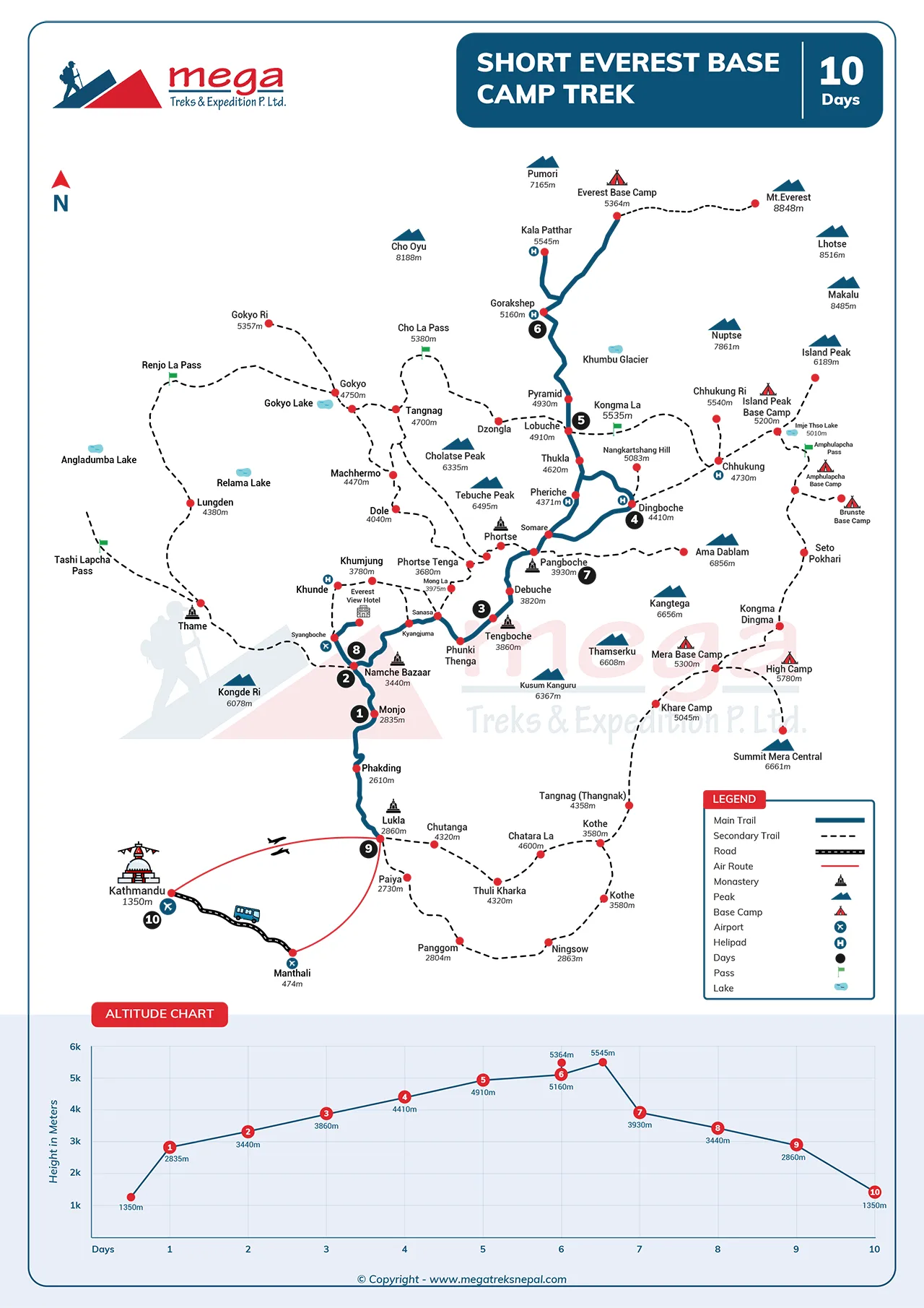
The Short Everest Base Camp Trek is tailored to suit the traveler wishing to enjoy the magnificence of the Everest region in a short period. In this 10-day adventure, scenic mountain flights, Sherpa villages of the world, and spectacular Himalayan scenery accompany the trekker and bring him to the foot of the highest mountain in the world. This path takes the traditional route via Lukla, Namche Bazaar, Tengboche, Dingboche, Lobuche and Gorakshep to the Everest Base Camp.
In the process, trekkers go through forests, bridges, and walk along rivers and mountain valleys. Every day is a new landscape as the trail slowly ascends from the lower altitudes to the high alpine terrain in the Khumbu region. Another benefit of the trip is the possibility to discover the local culture and see the everyday life of mountain communities.
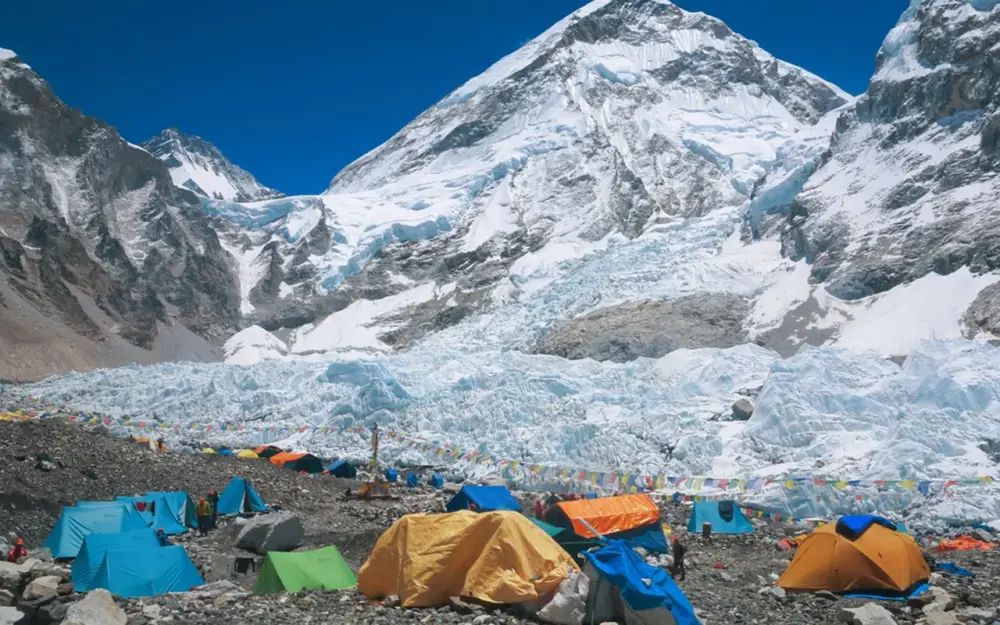
One of the highlights of the trek is arriving at the Everest Base Camp (5,364 m / 17,597 ft). Reaching this iconic place is a gratifying goal of numerous trekkers. The early morning hike to Kalapatthar (5,545 m / 18,192 ft) is also a memorable experience, as it provides a great view of Mount Everest and the Himalayan ranges around it.
The 10-day Everest Base Camp Trek will be the perfect adventure for active travelers who want to visit the Everest area but in a shorter itinerary without missing the key attractions. Despite the physical challenges of walking at higher altitudes, the trail is not beyond most trekkers who prepare well before they get to the trail. It is also accessible and enjoyable with comfortable teahouse accommodation, mountain hospitality and well-established trails.
The Short EBC Trek is a blend of adventure, natural beauty and personal achievement in a single rewarding adventure. If it is not your first walk in Nepal, or you are returning to the Himalayas, this route is an experience that would not be forgotten. Mega Treks pays special attention to the details of the trip in order to provide the trekkers with the chance to spend a safe and unforgettable time in the Everest area.
This adventure starts with an early morning flight from Kathmandu Airport to Lukla. This mountain flight is a short one and spectacularly provides a glimpse of the hills and the Himalayan scenery as it coasts down to Lukla (2,860 m / 9,383 ft). The trekking team finally makes its final preparations, and the trek begins on foot.
The initial day goes in the footsteps of Monjo along the picturesque mountain landscape and villages. Strolling along the river and through serene scenery will enable the trekkers to slowly acclimatize to the adventure. From here onwards, the path leads further into the Everest region to the Everest Base Camp.
The trip starts with the plane ride to Lukla and then proceeds with a hike to Monjo. In the morning, you will take a flight to Kathmandu and then a personal vehicle to the airport. It is there that you will take a flight to Lukla. The flight lasts approximately 30 minutes and flies over green hills and scenery of the Himalayan region. Once you reach Lukla (2,860 m / 9,383 ft), you will start your journey to Monjo.
The path leads further into the Khumbu region and also provides one with the mountain scenery surrounding it. As you proceed on, you will slowly approach Monjo (2,835 m / 9301 ft). The day is a scenic mountain flight along with the initial trekking experience of the trip. After visiting Monjo, you will be able to unwind and experience the serene environment of the place and close the day.


Today you will trek from Monjo to Namche Bazaar. The day starts with breathtaking scenery of the surrounding Himalayan scenery. You will go on after breakfast, along the trail which leads deep into the mountains. The path crosses woodlands and follows the Dudh Koshi River. Among the key attractions of the day is the passing of the Hillary Suspension Bridge and then on to greater heights.
The scenery is also changing as the trek moves on, and this provides spectacular views of the mountains. Taking a rest along the way, you will complete the last part of the ascendancy to Namche Bazaar (3,440 m / 11,286 ft). Along the way, you will also have the first sight of Mount Everest. Arrival at Namche Bazaar is a satisfying experience since the beautiful mountain village is a key point in the Everest region. The evening will be spent in the quiet settings.
Your journey will begin at Namche Bazaar and go to Tengboche. The morning will start at Namche Bazaar (3,440 m / 11,286 ft), where one can see the surrounding mountains. The current path has both slow climbs and downs as you proceed further into the Everest region. The route is through rhododendron forests and then descends to the valley of Dudh Koshi.
As you progress, you will be on the trail between Pungi Thanka and through classic Sherpa villages. The path then goes on a route followed by the yak caravans to Tengboche (3,860 m / 12,664 ft). One of the main highlights of the day is Tengboche Monastery. The monastery is famous because of its paintings, artwork, prayer flags, and prayer wheels.
Once you have scanned the surroundings and admired the serene environment, you will then be spending the night in Tengboche. Mountain scenery, forest trails, and cultural landmarks make this a fun day out in the trek.
The trek today is to Dingboche from Tengboche. The day starts with the sight of Ama Dablam at Tengboche (3,860 m / 12,664 ft). Then you will proceed on the trail after breakfast, and the road slowly ascends. The trail leads up steep inclinations and directs towards the stream that is situated to the south. As you climb further up the valley, the scenery starts to shift, and the influences of the growing elevation will be felt.
The trail takes a turn along the bank of the Imja Khola and then goes to Deboche. On the route, you will be walking through rhododendron woodland, which will contribute to the nature of the walk. The trail goes northwards, having passed the forested part. You will pass Pheriche and a green meadow and arrive at Dingboche (4,410 m / 14,468 ft). Once there, you may take time to see the area and appreciate the serene environment of this mountain town and then retire to sleep.
Today you will trek from Dingboche to Lobuche. Leaving Dingboche (4,410 m / 14,468 ft), the trail becomes steeper and steeper, so you progressively gain elevation. The vegetation is starting to wear away and gives way to a more barren terrain, and few shrubs and little pine trees are left on the path.
The path ascends gradually to Dughla and then a strenuous climb to Memorial Hill. This is the place where there are memorials of trekkers who died during their ascent of mountains in eastern Nepal. After a while in the vicinity, you will take the trail and proceed. The path provides spectacular scenery of the valley and mountainous landscape.
After lunch, the journey is made through icy and rocky landscapes. The last part is a gradual ascent, then followed by Lobuche (4,910 m / 16,109 ft). You will take a rest after a tedious day of trekking in mountainous terrain and look forward to the adventure.
You will begin your trek at Lobuche and proceed to Gorakshep and then hike to Everest Base Camp. The trek starts with a dramatic mountainous start as you walk out of Lobuche (4,910 m / 16,109 ft). The trail leads to Khumbu Glacier and progressively gets difficult. One of the daunting sections of the current journey is crossing the glacier area.
Once you have done this, you will reach Gorakshep (5,164 m / 16,942 ft). After taking a brief rest, you will proceed on a rough path to the Everest Base Camp. The path is along the mountainside, and finally, it leads to the Everest Base Camp, which is at (5,364 m / 17,597 ft).
The base camp has a sightseeing experience of the Himalayan scenery around before going back to Gorakshep on the same path. You will spend the night at Gorakshep after a whole day of trekking and exploring and are ready to take the hike the next morning.
The trip starts today with a hike from Gorakshep to Kalapatthar, and then down to Pangboche. In the morning, you will depart Gorakshep (5,164 m / 16,942 ft) and take an uphill path that is steep and above the glaciers around. It is not so easy but so fulfilling because the landscape is more and more impressive with each step.
Two to three hours of climbing will bring you to the peak of the trek, the Kalapatthar (5,545 m / 18,192 ft). Here you will have the sunrise and a panoramic view of the Khumbu Valley and Mount Everest. The mountainous nature of the location is a great place to capture photographs and take rest.
You will then embark on a long downward path after being at the viewpoint. You cross the Pheriche Valley on your way southwards. You will finally arrive at Pangboche (3,985 m / 13,074 ft), where you will be staying overnight after spending an active day in the high mountains.
You will trek today from Pangboche to Namche Bazaar. Then, once you are through with breakfast, you will start winding down the valley because the way that you will be following will be losing altitude. The path is heading towards Tengboche, and it goes through the same landscapes as those met earlier on the journey.
On your further walk, you will walk through Himalayan monasteries and see the hills and valleys around. Along the way, one can see a small part of the Monjo Valley. The highway then proceeds through forested lands with green plants. The gradual downward slope renders the current stroll more comfortable than the elevated part of the journey.
Slowly, the path goes back to Namche Bazaar (3,440 m / 11, 286 ft). The reappearance in this hectic mountain village gives one time to rest and reminisce on the trip through the Everest Region. The night may be spent in a tranquil mood prior to the last trekking day.
Your trip will begin at Namche Bazaar and go to Lukla. The day starts with Lhotse, Everest and Nuptse in sight, and the trail takes a southward direction. The path is along the Dudh Koshi River Valley and traverses suspension bridges as it slowly descends through the terrain.
The further you walk, the more forested the environment is. The path is through the alpine flora and places where the local wildlife and birds could be observed. It is also possible to see the national bird of Nepal, the Danfe, en route.
The path passes by serene Buddhist villages that are linked with stone paved roads. You will reach Lukla after a few hours of walking at (2,850 m / 9,350 ft). The trekking stage of the trip is completed when Lukla is reached. The evening can be spent resting and enjoying the successful accomplishment of the trek.
Today you will fly back to Kathmandu from Lukla. You will pack up after breakfast to leave Lukla (2,850 m / 9,350 ft). There is still time to savor the last mountain scene and ponder the trek experiences before departure.
Lukla flight provides vistas of the mountains, valleys, and hills beneath. You can also have a glimpse of Makalu and Everest through the window as the aircraft travels to Kathmandu. The brief flight is a final chance to enjoy the Himalayan view at the height.
Your destination will be Tribhuvan International Airport, Kathmandu, after some 30 minutes. When you arrive, you will be picked up by a private car to your hotel. The rest of the day can be used to relax and to enjoy the comfort of the city after completing your journey in the Everest region.

You can cutomize this trip as per your requirements if met the proper guidelines.


The ideal season to have the Short Everest Base Camp Trek is in spring between March and May and autumn between September and November. These are the months when the weather is generally stable, clear of mountains, and the trekking conditions are comfortable. The spring bloom brings rhododendron forests along the trail, and the autumn months are fine with clear air and good visibility, following the monsoon. Snow is possible, and winter hikes can be made more difficult by low temperatures.
Rain can also influence visibility and trail conditions during the monsoon months. The selection of the season will contribute to a more comfortable and pleasant journey. Most trekkers find these peak periods attractive since they have a higher chance of appreciating the mountain views along the path. Good planning can assist you in enjoying your trekking adventure.
The Short Everest Base Camp Trek entails a distance of about 119 kilometers in the trekking part of the trip. The path begins at Lukla (2,860 m / 9,383 ft) and then ascends steadily through Namche Bazaar, Tengboche, Dingboche, Lobuche and Gorakshep. This trek arrives at the Everest Base Camp (5,364 m / 17,597 ft), followed by Kalapatthar (5,545 m / 18,192 ft), the highest point of the trek.
The route incorporates uphill and downhill climbs in the mountain valleys and forests and the high alpine terrain. Even though the distance is not very far, such that it cannot be traversed by many trekkers, the rising elevation might make walking more challenging. The slow pace and the correct acclimatization assist trekkers in adapting to the altitude and make the journey safe and comfortable.
The Short EBC Trek is considered moderately challenging. Daily trekking entails a number of hours of walking over mountain paths, including a number of uphill and downhill stretches. This is more challenging at higher altitudes above Dingboche. The trek has an elevation of Everest Base Camp of (5,364 m / 17,597 ft) and Kalapatthar of (5,545 m / 18,192 ft), meaning that some trekkers can experience altitude sickness. The most frequent symptoms can be headaches, fatigue, appetite loss or insomnia.
The risk may be mitigated by walking at a moderate speed, drinking water and being able to stick to the itinerary. Trekkers are to take care of their bodies and report to their guide in case they are not feeling well. The correct planning and reasonable trekking practices can make the tour more reassuring and a pleasure.
During the 10 days Everest Base Camp Trek, there are variations in walking hours. The average trekking days are 4 to 5 hours, with a maximum being 8 to 9 hours. The distance is also affected by the route and elevation gain. There are days of slow ascents into forests and villages and days of more extended walks over more difficult and elevated landscapes. Most often, the day to Everest Base Camp and the hike to Kalapatthar are the most challenging part of the trek.
Although there are days that are longer, trekkers travel at a moderate speed, taking frequent breaks in between. Good physical conditioning can be used to make the day-to-day walking routine less hectic and enable the trekkers to appreciate the experience better.
The Short Everest Base Camp Trek usually accommodates in local teahouses along the way. These lodges will provide simple yet comfortable rooms that the trekkers can take a rest in at the end of every day of walking. Dining rooms are available as a leisure room, where one can have meals and get to know other trekkers. Food choices tend to have a range of local and foreign foods that assist in boosting energy for the trek.
Food is made at the lodges fresh, and it gets easier at higher elevations. There are many hot drinks all over the route. Consumption of fluids is essential at higher altitudes. The higher the elevation, the fewer the facilities, but most trekkers are content with the accommodations and food provided to them to conduct the journey. Mega Treks assists in organizing the services needed during the trek.
Trekker has a number of other options that may provide them with an alternative experience in the Everest area. Others are a mix of Everest Base Camp and Gokyo Lakes, and some are a mix of Cho La Pass, which is an even more demanding adventure. The routes take more days than the Short Everest Base Camp Trek and demand more fitness and endurance. The conventional path is the most common option as it offers direct access to the Everest Base Camp and Kalapatthar with less time.
This itinerary is popular among trekkers who have limited time to spend on vacation in the area, as it highlights the key attractions of the area. Other paths can lead to other mountain scenery, less-traveled paths, and various scenery, though they are usually more time-consuming. The decision to follow the correct route will be based on your time, physical fitness and ambition to trek.
Yes, beginners will be allowed to join the Short Everest Base Camp Trek as long as they prepare well prior to the trip. Experience in trekking is desirable though not essential. It is a multi-day hike with the walk at ever- rising levels, so a moderate degree of fitness is essential. Before coming to Nepal, beginners are advised to work on their stamina by walking, hiking, joggin or engaging in any other cardiovascular activity.
The path ascends steadily up Lukla (2,860 m / 9,383 ft) to Kalapatthar (5,545 m / 18,192 ft), an elevation that is a significant consideration. A slow-paced walk and taking instructions given by the guides can make the trip more comfortable. This route is completed by many first-time trekkers with the right preparation, expectations, and a positive attitude during the trek.
The 10-day Everest Base Camp Trek can be more comfortable and enjoyable with good preparation. The physical preparation of trekkers should commence several weeks before the trip. Endurance and the strength of the legs can be improved with the help of activities like walking, hiking, cycling, running, and stair climbing. Stamina is necessary since the trek will consist of a number of days in a row of walking in hilly areas.
It is also useful to get used to having a small daypack on when training. Mental preparation is also essential, because the weather conditions and protracted trekking days may prove to be difficult. Appropriate trekking gear, appropriate clothing and well-fitting boots can enhance comfort during the trip. Prior preparation will alleviate fatigue and enable the trekkers to concentrate on the landscapes, villages, and mountain scenery encountered in the trek.
Most of the teahouses along the trekking route have charging facilities and internet services. Availability can vary according to the place and weather conditions. Charging services may become scarce as the trek goes to elevated levels. Most trekkers carry a power bank to have phones, cameras, and other devices charged on the way. Some of the villages are connected to the internet, but the speed might be low as opposed to those in the city.
The quality of networks usually varies with the location and weather. High-speed internet along the route is not something that Trekkers should expect. Before the trek, it is handy to have significant data stored on devices and then begin the trek. In most places, basic connectivity is offered, and trekkers are able to keep in touch with their family and friends when necessary.
The Short Everest Base Camp Trek is subject to several permits. Trekkers require a Khumbu Pasang Lhamu Rural Municipality Permit and Sagarmatha National Park Entry Permit. The permits aid in conservation and management of tourism in the Everest region. Checks on permits occur at checkpoints along the trekking path. Permit documents should also be carried during the trip since they might be demanded by the native officers. The majority of trekkers book their permits with their trekking agency prior to commencing the trek.
Owning the necessary permits guarantees the legality of access to the area and gives some help to preserve the natural and cultural environment. The requirement of permits may sometimes vary; hence, it is always good to make sure that one has the most recent information before travelling. Mega Treks will be able to help in the preparation of the required permits.
The trek starts with a flight from Kathmandu to Lukla, which carries them to their destination. It is a significant component of the total experience and allows reaching the Everest region by this short mountain flight. The flight typically lasts about 30 minutes and provides the scenery of hills and mountain landscapes below. Travelers take the trek back to Kathmandu on flying after the trek.
The trekking package normally includes airport transfers. At times, weather conditions may influence flight schedules, particularly when flying in mountainous areas. Travelers are advised to give their travel plans some leeway in case of delays. The flight connection assists in cutting down on the travel time and allows completion of the Short EBC Trek in a shorter itinerary and still achieve the Everest Base Camp and Kalapatthar.
Anyone who is participating in the Short Everest Base Camp Trek is highly advised to purchase travel insurance. The high-altitude trekking activities and emergency medical conditions should be included in a suitable policy. The trek will go up to Kalapatthar (5,545 m / 18,192 ft), which is why you should ensure that your insurance policy covers altitudes above 5,000 meters. Unexpected events like illness, injury, problems with trips or emergency evacuation can be insured against.
When buying the insurance, trekkers must thoroughly examine the policy terms. It is also advisable to carry a copy of your insurance details in case of a trek. Travel insurance will give you a sense of comfort and will assist in knowing that you will get help in case of need. It is an inexpensive investment, which may prove useful when on high-altitude treks.
The Short Everest Base Camp Trek is a fulfilling adventure in the core of the Everest area. Trekking guests are likely to see mountainous landscapes, ancient villages, suspension bridges, forests and mountainous terrain. The trail goes through established villages like Namche Bazaar, Tengboche, Dingboche, Lobuche and Gorakshep and then up to Everest Base Camp (5,364 m / 17,597 ft).
One of the trip highlights is the hike to Kalapatthar (5,545 m / 18,192 ft), which offers excellent views of the mountain. The hike is a few days of hiking and a progressive increase in elevation. On the trail, trekkers get to explore local culture, mountain hospitality and a shifting landscape. The trek can be physically daunting at some point, but is rewarded by unforgettable experiences and a sense of accomplishment upon success.
The climb is of moderate difficulty and it can be taken by anyone who is well-fit and with the spirit of perseverance.
The highest point is Kalapatthar (5,545 m / 18,192 ft).
The typical route is accomplished in 10 days.
No, not necessary, although experience with trekking is useful.
Yes, altitude sickness may be experienced by the trekkers since the path is at high altitude.
The best seasons of trekking are said to be spring and autumn.
You require a Sagarmatha National Park Permit and a Khumbu Pasang Lhamu Rural Municipality Permit.
Yes, high-altitude trekking travel insurance is highly recommended.
During the trek, accommodation is offered at local teahouses.
In most villages, charging services are offered, but they can be accompanied by extra charges.
There are various places where Internet is provided but speed and reliability can be different.
The necessary things comprise warm clothes, trekking shoes, a sleeping bag and personal equipment.
Yes, beginner who are well equipped and fit can be able to carry through the trek.


 Write a Review


