
Talk To Expert
Mail Us

Trip Duration
20 Days
Group Sizes
2-16 People
Difficulty
Difficult
Max. Altitude
5360 m
Activities

Meals

Accommodation
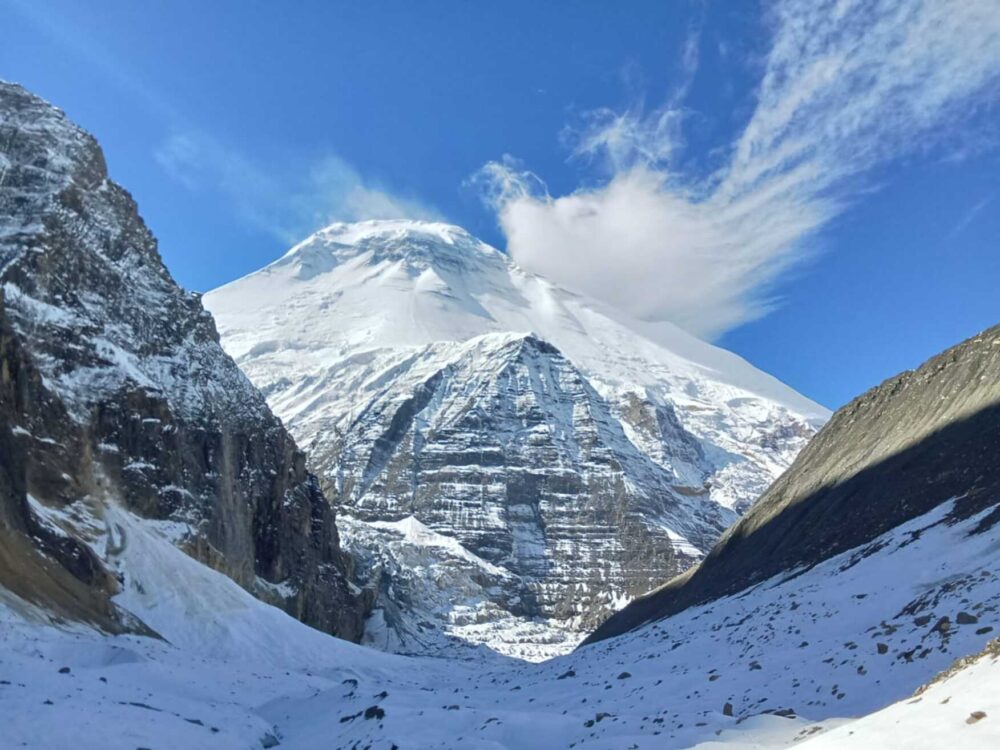
The Dhaulagiri Circuit Trek is not just an ordinary trek; it is a challenge that combines silence, altitude, and the remoteness of nature. This twenty-day trek goes through the western sides of the Annapurna Valley, around the seventh-highest mountain in the world, Mt. Dhaulagiri (8,167m), following the deep valleys, glaciers, high passes in the Alps, and vintage villages that look to have been lost in time.
The Dhaulagiri Circuit Trek is not as commercialized as the Everest or the Annapurna Base Camp, and it is simply a remote and physically demanding journey. It is an adventure for anyone who wants to enjoy the peace. Like the green lowlands of Beni to the frozen wasteland of Hidden Valley, every single step can test your body and stretch your perception of scale, the geographical, the emotional, the spiritual.
The journey starts in Kathmandu with preparation and anticipation. The actual trek then starts after a long drive to Beni and a rough ride on the jeep to Dharbang, along terraced hillsides, rhododendron forests, and Magar villages like Muri and Boghara. The higher the altitude, the more the silence. Italian Base Camp (3,660m) gives the first hint of isolation in the Alps; Japanese Base Camp and Dhauligari Base Camp (4,740m) put the trekkers in the world of ice and rock, with high walls of snow on all sides.
The passage over (5,360m) French Pass is the most stunning one. It is the sequence of the Dhaulagiri mountain range into the dreadful beauty of Hidden Valley, the silence of the valley, the surreal light. Those who have the strength and desire may go to ascend on Dhampus Peak (6,035m), which has a panoramic view which is impossible to describe. The trail down Dhampus Pass (5,258m) takes you to the village of Yak Kharka and later on to the colorful village of Marpha with its apple trees and Thakali hospitality.
The last ride towards Jomsom involves sightseeing the Dhumba Lake and Thini Village, which introduces layers of myth and memory to the pilgrimage. Trekking there, you have an option of either flight or driving to Pokhara, where showers, warm and lakeside cafes, are surreal after two weeks of outdoor life. The trip back to Kathmandu gives time to think, rest, and maybe in the process start planning the next adventure.
This package is aimed for advanced trekkers who are ready to climb high and experience nature and originality. It covers all the logistics, including transport, permits, guides, porters, meals, and accommodation. The itinerary is balanced between both physical challenge and culture. The Dhaulagiri Circuit Trek is one of the rare experiences where you can have anything, be it a summit, culture, experience or any other thing.
Your journey begins after just landing in Kathmandu, and you enter a city rich with history and culture. The air is hot, smelling of incense, and the busy streets indicate the beginning of your journey. One of our representatives will be there to pick you up at the airport and take you to a hotel in Thamel. No height gain today, and psychologically, the climbing starts. You relax and have tea, and see prayer flags fluttering over the streets.
The night is still and is devoid of conversations and nervous anticipation. This is your jumping off point; Kathmandu, a city of 1,400 meters, where ancient temples and both modern and disorderly chaos coexist. The actual preparation will start tomorrow. Tonight you sleep, and the mountains are calling already.


Today is a preparatory, adventurous, free day between arrival and adventure. You get to know your guide, get the last-minute papers, and check your equipment like boots, poles, down jacket, and your mental preparation. You can take a leisurely walk around the Swayambhunath in case you have time, and the monkeys guard old stupas, and the prayer wheels spin all around there. The spiritual vibe of Kathmandu is a refreshing experience.
You can go to a trekking shop and get last-minute necessities, or just sit in a cafe in and see the city going by. However, it is a day of preparation, not physical but also emotional. You are abandoning comfort and going into a place where it will be silence and snow and solitude that will make every step.
The trip starts by taking a long off-road trip in westward around the middle hills of Nepal to the town of Beni. You leave Kathmandu early, and gradually you move downwards by evening. The highway is a combination of adventurous and dusty roads in between villages along rivers, farms. You will have lunch somewhere near Pokhara, and you will have a glimpse of Annapurna.
The last large town before the remoteness is Beni, located at the junction of the Kali Gandaki and Myagdi rivers. You will stay in a small lodge today, relax, and experience the change. Tomorrow, the trail begins.
After having breakfast, you go on a rugged jeep on a rough ride to the small village of Dharbang, which is situated at 1,180 meters. The road cuts through the cliffs with suspension bridges. From Dharbang, your feet finally touch the trekking trail. You start walking up to Dharapani, and ascend through forested areas and enter the Magar village.
It is not only a symbolic step into the circuit, but a climb up to 1,560 meters is gradual. You move ahead, passing the watermills, children playing in grounds, and prayer flags flying over stone walls. Towards the end of the afternoon, you arrive at Dharapani, a small village where the lodging looms are not that luxurious, but everyone welcomes you with a warm smile.
Today’s climb takes you further up into the Myagdi valley, where you hike as high as 1,560 meters and down to 1,850 meters, all the way to Muri. The path ascends terraced fields, huge forests, and small ridgelines and gives us glimpses into the Dhaulagiri range.
You cross the Myagdi Khola on a suspension bridge and climb the steep stone steps carved out of the side of the hill. On route, you pass by Magar village where old-fashioned houses are standing on the hillsides and children welcome you with a big curiosity. Muri is a beautiful village overlooking the valley that is surrounded by maize fields and rhododendron trees. The atmosphere is colder, and the silence is even greater.
As Muri is left behind, the trail is now narrower, and the landscape becomes even wilder. You go slowly up the thick woods and the terraced lands over little rivers. This route has adventurous trail and descents, but the descents are short and successively climbed, until the final destination of the path is reached at Boghara 2, 080 meters.
This distant village is dangling on the hillside, and it is surrounded by fields of maize and bushy ridges. You can see old Magar houses, children waving excitedly at you, and animals gazing at the grass. The air is cooler, and the canopy of the forest is made. A place like Boghara is a border of civilization, a place of wildness. You will be staying in a teahouse, knowing that hereafter there is a further boundary of road, a greater introduction of altitude, and deep silence echoing around you.
The trail today takes us farther into the valley of Myagdi, and is a combination of sharp ascents and perilous descents that are through the dense jungle. You are up before daylight, as you will be climbing up through bamboo swamps and moss-grown rocks, and most of the way near to the sides of steep rocks above the thundering Myagdi Khola.
The altitude is increased to 2,520 meters, and the landscape gets rougher. You go through a few little wooden bridges and through forest clearings where the langurs are jumping through the trees. Doban is a little clearing in the woods, rather a camping place than a village, which is on the side of the river. The air is damp, and the surroundings are quiet. You put up camp or even set yourself up with some simple form of shelter, listen to the sound of the river, and rest here.
The forest becomes thin as mountainousness occupies itself. The journey to the Italian Base from Doban is uphill, and you cover more than 1,100 meters in one day. The path is bordered by rhododendron trees and rocky land, and Dhaulagiri can be occasionally seen in the icy flanks, viewed like a mirage.
The landscape changes at the terminal of the Myagdi Glacier, where the green cover-up of the lowland is replaced by grey rock and glacial dust. Italian Base Camp is located at 3,660 meters with the huge cliffs and avalanche-prone slopes. The atmosphere has lean air, and the silence is absolute. Tonight you will sleep under stars and snow, and enjoy the beauty of the Himalayas and prepare for the acclimatization day.
It is a rest day today, a day to allow your body to acclimatize to the height. You get up gradually, with the difficulty of breathing due to the thin air. A small increase in altitude in the surroundings of the base camp contributes to increasing the circulation without excessive workload. You can visit glacial ridges, take small hikes, and see the clouds drift near the summit of Dhaulagiri.
The camp is plain in itself, tents are pitched on gravel, and there is nothing but silence. Food is plain here with fewer options. This is a critical day in acclimating your body to avoid altitude sickness before moving to the higher camps. Italian Base Camp is not just a stopover; it is an address of confrontation, where the ambition of every trekker comes to its knees, and the mountain starts testing your determination.
You are out of the Italian Base Camp now and into a world of ice, rock, and adventure. The path ascends continuously up to 4,000 meters, passing through pieces of glaciers and steep ridges. The climb is gradual, step by step, a deal with height. You cross under cliffs that have collapsing ice and slender crevasses, which are roped.
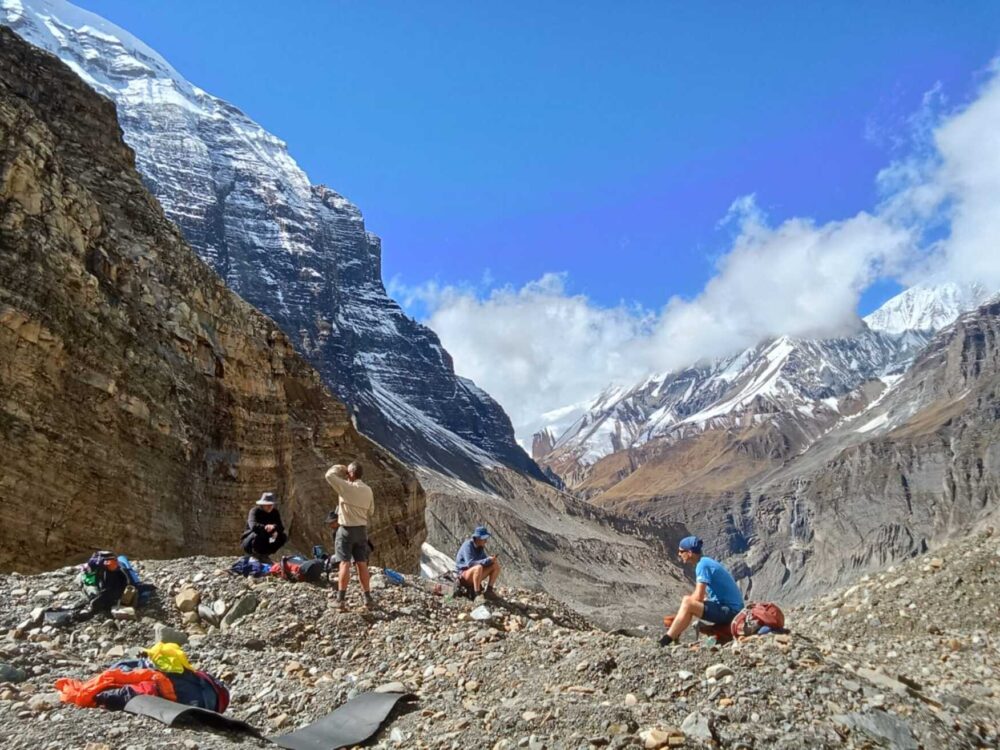
The Japanese Base Camp is a sharp plateau that is enclosed by ice walls and glacial waters, which has some amazing views of the north side of Dhaulagiri. It is colder, and the air becomes thinner, and the landscape looks like you just entered the moon. There are no villages here, just wind and rock and the snorting and shaking of ice. You are sleeping in silence, understanding that the next day, you will be pushed deeper into the world of the Himalayas, on your way to Dhaulagiri Base Camp.
You get up early out of the Japanese Base Camp and enter a land of ice and silence. The path ascends gradually on top of a glacial moraine, and loose rocks and crevasses require you to take cautious steps. As you climb up to 4,740 meters, the air becomes thin and the scenery is surreal with huge ice walls, wind-carved ridges, and the huge Dhaulagiri standing in front of you.
The base camp is at the foot of the north side of the mountain, a huge area of snow and rock. You get your tents on gravel, where there is absolute silence, but the crack of shifting ice is can be heard clearly. It is the centre of the circuit where ambition goes to meet altitude. You are sleeping tonight under stars and glaciers, and you know tomorrow you will pass one of the highest passes in the Himalayas.
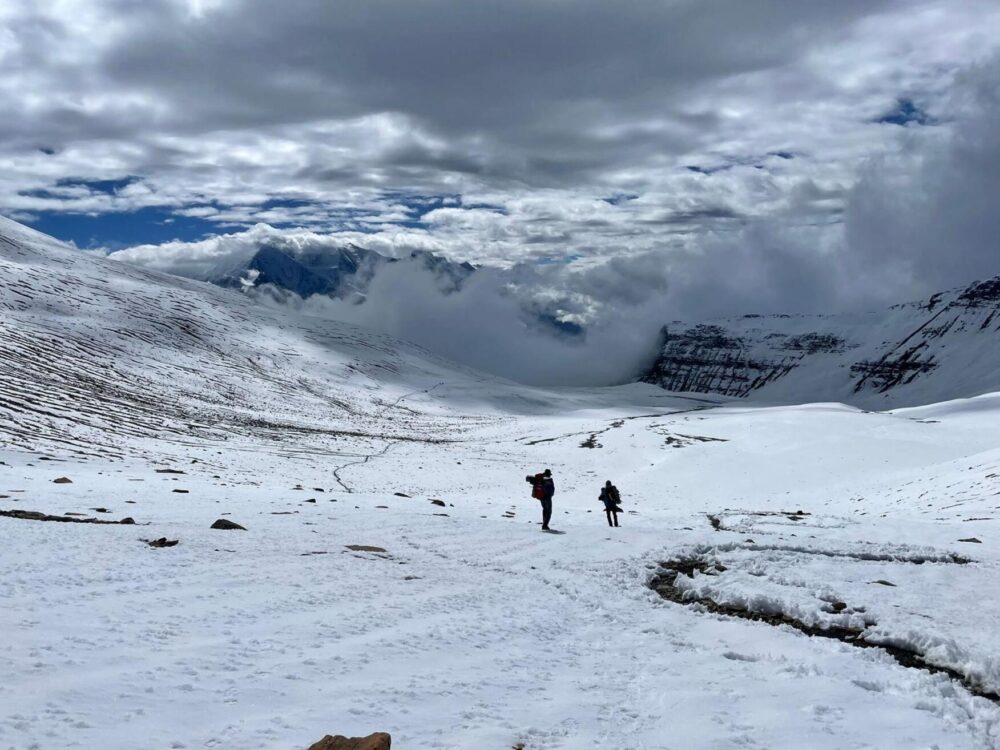
It is one of the most challenging and adventurous days of the trek today. You wake up early in the morning, dress up against the cold, and then start the gradual climb to French Pass (5,360m). The ascent is gradual yet unbreakable, which goes through snow-fields and wind-tossed ridges. Prayer flags can be seen at the back of the same Infinity of peaks like Dhaulagiri, Tukuche, and others.
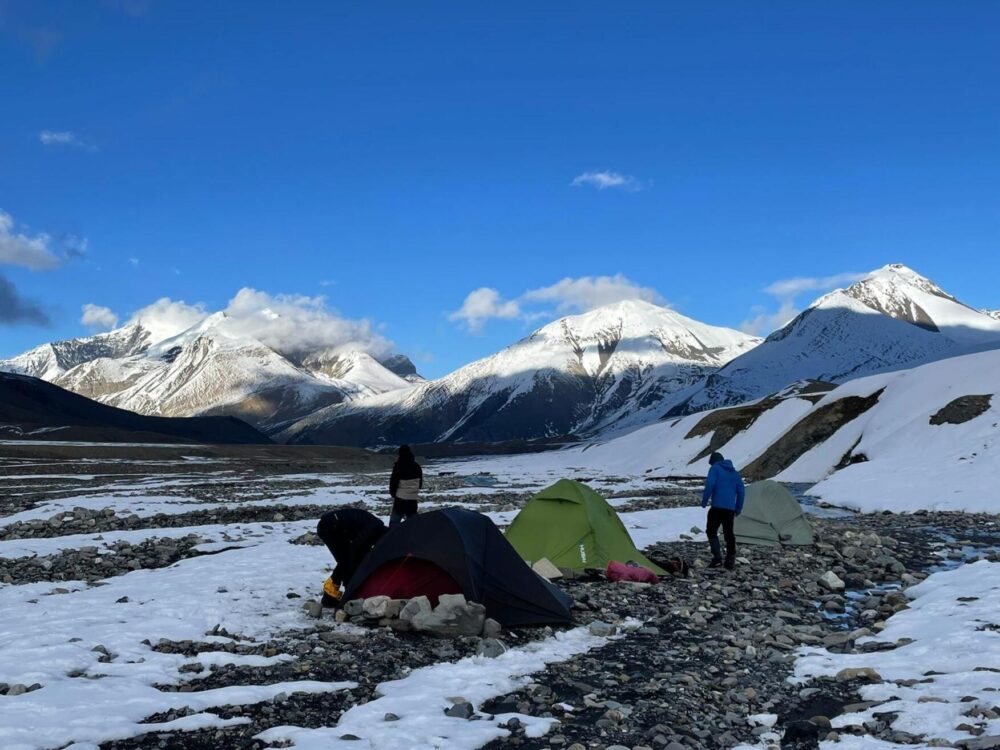
Then comes the descent, down to the valley of Hidden Valley, a high-altitude valley, 5,050 meters, encircled by sharp peaks. The land looks like the land on the moon we’ve imagined, air becomes lean and dry. You camp alone, in with snow and sky. It is a holy valley, remote, peaceful, and quiet. You are in the world of Himalayas.
You start walking out of camp early, towards Dhampus Pass (5,258m); the last challenge of high altitude. The trail is very sharp, consisting of switchbacks made of ice and open ridges. An adventurous ascent to Dhampus Peak (6,035m) can also welcome you with panoramic views of Annapurna, Nilgiri, and the desert plains of Mustang to the people who have the stamina and ambition to do so.
The peak is a success, without which, the pass is a masterpiece. At Dhampus Pass, a lengthy downward trail leads to Yak Kharka (3,680m), descending by almost a thousand and six hundred meters through alpine meadows. The atmosphere becomes denser, and the landscape makes it softer. Yak Kharka is a high-altitude grassland that has stone shelters and animals. Here you sleep with tired legs and a high spirit. The most difficult days are over.
The modern road will take you to the cultural core of Mustang. After leaving Yak Kharka and the pine forests, along with the dry water courses, you move steadily down to Marpha, a pretty Thakali village, 2,670 meters in the higher altitude.
The path has been smoothed out and goes around through apple gardens, chortens, and prayer wheels. You are welcomed in Marpha with washed-out houses, pavements of slate, and cider. You walk around and see monasteries, meet people, and enjoy fresh apple pie; a surreal luxury after eating freeze-dried food. The elevation is smooth, the atmosphere is hot. Marpha is a healing and thought-resting place, where the mountains mellow down and tales start to form. Now you are sleeping in comfort.
On the last day of the trek, you start a short walk to the tourist centre of Mustang, Jomsom. The path is dry and windy and leads up the Kali Gandaki River. You divert before you can reach Dhumba Lake, a glacial turquoise lake that is holy to both Buddhists and Hindus. The lake shines under the cliffs, which gives a silent scene of admiration.
You also go to Thini Village, which is among the oldest settlements in the area, and the stone houses and old customs remain here. At 2,720 meters, Jomsom seems like a reversion to civilization with pastry shops and bustling markets. You enter a guesthouse and can also recall your whole journey till the day. Today, you can celebrate the end of the trail because tomorrow you are flying or driving to Pokhara.
You wake up in the town of Jomsom, where the dust has already been blown on the runway. In case the weather is good, you take a short flight to Pokhara and fly over the Kali Gandaki gorge to see Nilgiri and Annapurna. When flying is not an option, the drive is a long, scenic one and goes through the cliffs of Mustang and the green middle hills.
Reaching Pokhara at an elevation of 827 meters is surreal because of the cafes and lively streets, you can take a walk by the lakeside, and the warm air indicates the change in altitude. You get yourself into a nice hotel, have a shower, and rest for the day. The pace of the city is calm, and the locals are friendly.
The day is yours now, you can spend it in the way you want to. No rush, no alarms, no elevation. The beauty of the lakeside in Pokhara can be encouraging to walk around, maybe by a boat ride in the Phewa Lake, the Peace Pagoda, or you can just have a cup of coffee with a Machhapuchre in sight. Your body takes a break, and your mind starts to work out the adventurous trip of the trek.
You can write in journals, buy souvenirs, or sit down and share stories with other trekkers. Pokhara is a peaceful place, where the mountains are visible but no longer challenging. You stand there, think, and start to experience the change that can be created only during long journeys. Tomorrow you will go back to Kathmandu, the place where you started your journey from.
You leave Pokhara either by flight or bus, taking yourself through the route that took you to the mountains. The flight is short, giving aerial views of the Himalayas that you have seen right in front of you. The ride by bus is more adventurous, and it passes through the valleys along the banks of rivers and through towns.
One way or another, you reach Kathmandu feeling accomplished and exhausted as well. The city is now becoming familiar; its noise is not as shocking, its rhythm is more comprehended. You come back to your hotel in Thamel, and you see the same streets that you were on a few weeks ago. The altitude once again increases to 1,400 meters, and the adventure is no longer about the altitude. It’s about return. You have traveled wild places, high passes, and today, you have come full circle.
It is a silent celebration on this last full day. You go back to some of the popular Kathmandu locations like Durbar Square, Boudhanath, or even a cafeteria with unrestricted views. You can sit and have a farewell tea with your guide, buy prayer flags or trekking souvenirs, or just sit and watch the city. The mind meditative, the body slumbering.
You’ve earned this stillness. Kathmandu, which used to be a place of anticipation, now seems like a form of closure. You look back at the most difficult moments of the trek, its silent victories, and the sceneries that changed your understanding of the proportions. You are leaving tomorrow, but today, you celebrate the journey you’ve come from.

You can cutomize this trip as per your requirements if met the proper guidelines.
The best seasons to go for the Dhaulagiri Circuit Trek are spring (March to May) and autumn (September to November). Nepal also welcomes the spring with blooming rhododendron, stable weather, and clear skies. The weather is average, and the trails are colorful and rich in life. After the monsoon, autumn brings cool weather, clear skies, and dry weather, which is best suited to high-altitude trekking. The months not to go for or be extra cautious should be either winter cold or the summer rains. So, spring and autumn are the safest months to cross the high passes, such as the French and Dhampus, during the Dhaulagiri Circuit trek.
Winters (December to February) are severe, and due to snow, trails can be blocked and the possibility of avalanches rises significantly. Slippery tracks, leeches, and common landslides, particularly in the forested areas such as Boghara and Doban, are the worst part of the monsoon (June to August). When such a remote and challenging trek as the Dhaulagiri circuit trek is involved, choosing the best season is an essential consideration, not only in terms of comfort but success and safety, as well. The spring and fall have the optimal mix of accessibility, beauty, and stability at the altitude.
Training for the Dhaulagiri Circuit Trek requires physical training, psychological endurance, and logistical preparation. Firstly, start the pre-training at least two months before the date, with cardio, strength, endurance, and particularly, uphill hiking with a loaded backpack. The most important one is acclimatization, so add practice elevation at the altitude where possible.
Learn the route, familiarize yourself with the changes that are going to occur in the elevation, and get ready to spend long days in isolated areas. Extremely cold, snow, and wind-resistant pack gear, such as layered clothing, heavy boots, and a four-season sleeping bag. Guide and porter arrangements check early and secure permits (TIMS and ACAP).
Psychological training is also important as this journey is lonely, physically challenging, and emotionally charged. Be ready to have low connectivity, extremely few facilities, and unreliable weather. A trekker who is well prepared is not only a fit person, but they are flexible, knowledgeable, and adaptable. Dhaulagiri Circuit trek is a rewarding circuit for those who do not disregard its size and prepare beforehand.
Yes, the Acute Mountain Sickness (AMS) is a major danger of the Dhaulagiri Circuit Trek because of its steep ascent and the various high-altitude camps. AMS develops when the body does not adapt well to a low oxygen supply at high altitude, which is usually over 2,500 meters. The symptoms consist of headache, nausea, dizziness, fatigue, loss of appetite, and disturbed sleep. More serious ones, such as High Altitude Pulmonary Edema (HAPE) and High Altitude Cerebral Edema (HACE), are life-threatening.
Some of the risky zones on this trek are Italian Base Camp (3,660m), Dhaulagiri Base Camp (4,740m), French Pass (5,360m), and Hidden Valley (5,050m). To detect AMS at the earliest stage, keep track of the symptoms every day, and do not overlook long-term headaches and vomiting. The best remedy is to get to a lower altitude at once. Small efforts, like as Rest, hydration, and medications such as Diamox, may help but not replace acclimatization. Plan gradual days of acclimatization, take it step by step, and pay attention to your body. AMS can be avoided through caution during the Dhaulagiri circuit trek.
The Dhaulagiri Circuit Trek requires experienced guides and porters. The road is isolated, and it passes through glaciers, avalanche-prone areas, and few infrastructures. A trained guide is a guarantee of safety, direction, and cultural understanding. They oversee logistics, track symptoms of the altitude, and organize emergency responses in case, when necessary.
Porters carry the equipment, and this will help to reduce your physical load and help you acclimate better. Ethical trekking implies observation of the limits of porter weight and fair payments, food, and insurance. A variety of guides belong to the local communities, such as Marpha or Beni, who know the land and even the tradition.
Trekking companies usually offer experienced groups that are conversant with the difficulties in the Dhaulagiri region. This is not suitable for a solo trek as there is isolation and risk. The journey is not only safer with the right crew, but much better, more connected, and very adventurous. Your guide and porter are not merely a support system, but they are a part of the story of your journey.
Dhauligiri Circuit Trek is considered to be one of the most difficult trails in Nepal as it requires a lot of fitness, psychological stamina, and logistical accuracy. It is challenging in terms of elevation, seclusion, and topography. Trekkers have to cross over two high passes, which are French Pass (5,360m) and Dhampus Pass (5,258m), with steep ascents and open ridges.
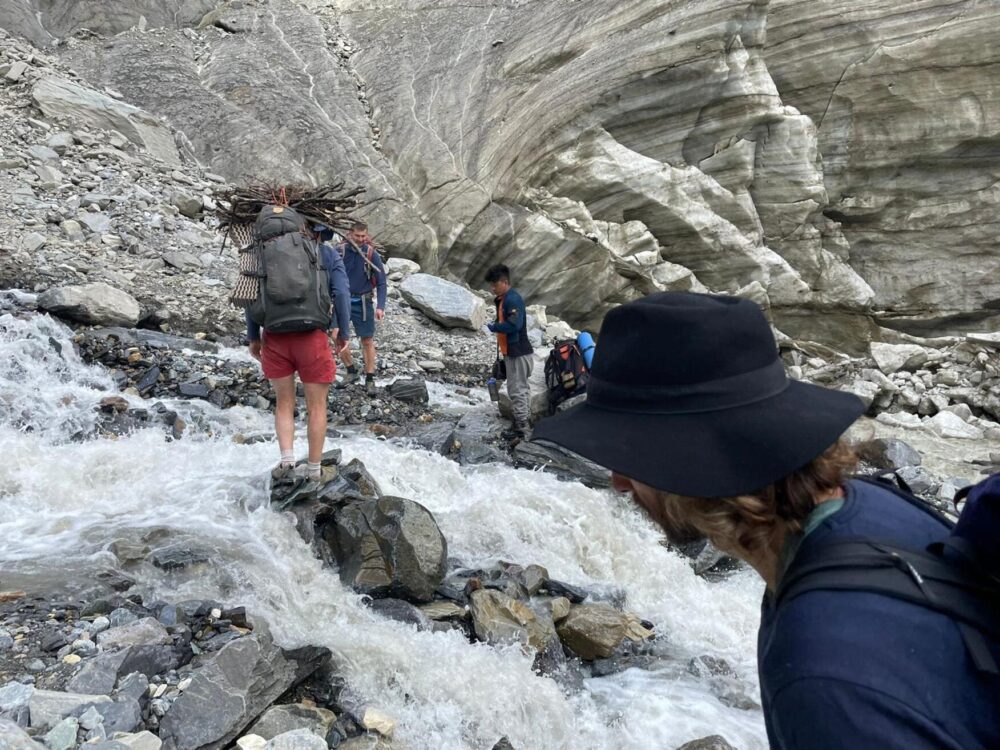
Hidden Valley Camp and Dhaulagiri Base Camp are remote camps with no teahouses and little access to the rescue team. The weather is highly unpredictable, particularly around the glaciers and avalanche areas. The route has long days (6- 9 hours), crossings along rivers, and unstable moraine roads. There is extremely minimal infrastructure, in the form of no Wi-Fi, food, or plain shelter, unlike popular routes.
You have to bring the right equipment, get used to it, and you have to be psychologically ready to stay alone. Strategic pacing, acclimatization days, and guide and porter assistance make it manageable. The hike is not technical and is physically and emotionally exhausting. It is an adventure for experienced hikers who want to enjoy the remote nature and not the comfort. Challenge is no obstacle in this case; it is the nature of the experience.
The Dhaulagiri circuit trek requires two essential permits, which are the TIMS (Trekkers’ Information Management System) card and the Annapurna Conservation Area Permit (ACAP). The Nepal Tourism Board issues the TIMS card to assist authorities in monitoring the trekkers in terms of safety and emergency management.
The ACAP is necessitated by the fact that a large portion of the trail goes through preserve areas within the Annapurna Conservation Area in the form of forests, alpine meadows, and glacial valleys. This license helps in conservation, local infrastructure, and sustainable tourism. The two permits are obligatory and required before departing from Kathmandu or Pokhara.
They are a guarantee of legal access to the region and support the development of the environment and communities. Being an isolated location and traversing a high-risk area, such as avalanche areas and glacial basins, the availability of adequate documentation also eases the rescue coordination in case of necessity. It is unlawful to go trekking without the permits, as it may attract fines or the refusal to gain access at roadblocks.
The Dhaulagiri Circuit Trek needs a certain level of precision and layering in terms of packing to be correct. You will be required to have moisture-wicking base clothes, insulated middle clothes, and a waterproof outer jacket to take care of snow, wind, and unexpected drops in temperature.
At high camps at night, a four-season sleeping bag with a rating of -20°C is required. Shoes must have worn trekking boots with ankle support and microspikes or crampons on the parts of the route that are icy. Also carry thermal gloves and woolen socks and a warm hat, sunscreen, and UV-protective sunglasses to take care of glacier glare. The hydration system and headlamp are the two conditions that the backpack is made of strong material and covers the whole bag with a raincoat.
Add altitude medication, water purification pills, as well as a primitive first-aid kit. Also, don’t forget such necessities as trekking poles, lip balm, snacks, and a journal. All the items must have the purpose- comfort, safety, or survival. The wildness of the Dhauligiri circuit trek will test your survival skills with what you are carrying and how you are going to adapt and survive.
It usually takes 18 to 20 days to complete the full circuit.
French Pass at 5,360 meters is the highest point on the route.
No, it’s recommended only for experienced trekkers due to altitude and remoteness. But the beginners can also go for it, with full preparation ahead of the trek.
Yes, a licensed guide is strongly recommended for safety and navigation.
Yes, porters can be arranged through trekking agencies or guides.
You need a TIMS card and an Annapurna Conservation Area Permit (ACAP).
Yes, AMS is a serious risk above 2,500 meters and must be monitored closely.
No, the last reliable ATM is in Kathmandu or Pokhara; carry enough cash.
Yes, but you must purify it using tablets or filters due to contamination risks.
Basic Nepali meals like dal bhat, noodles, and tea are available in lower villages.
Yes, especially in higher sections like Hidden Valley and Dhaulagiri Base Camp.
Charging is limited, so bring a solar charger or power bank for remote camps.
Coverage is patchy and unreliable after Boghara, expect full disconnection.
Teahouses in lower villages and tents in high-altitude camps.
Temperatures can drop below –15°C at higher camps like Hidden Valley.
Yes, insurance covering high-altitude trekking and helicopter evacuation is essential.
Solo trekking is discouraged due to isolation and safety risks.
Yes, villages like Marpha and Thini offer rich Thakali and Buddhist heritage.
Yes, flights and passes may be delayed due to snow, wind, or poor visibility.


 Write a Review


